20200615

Garnsey's Tower

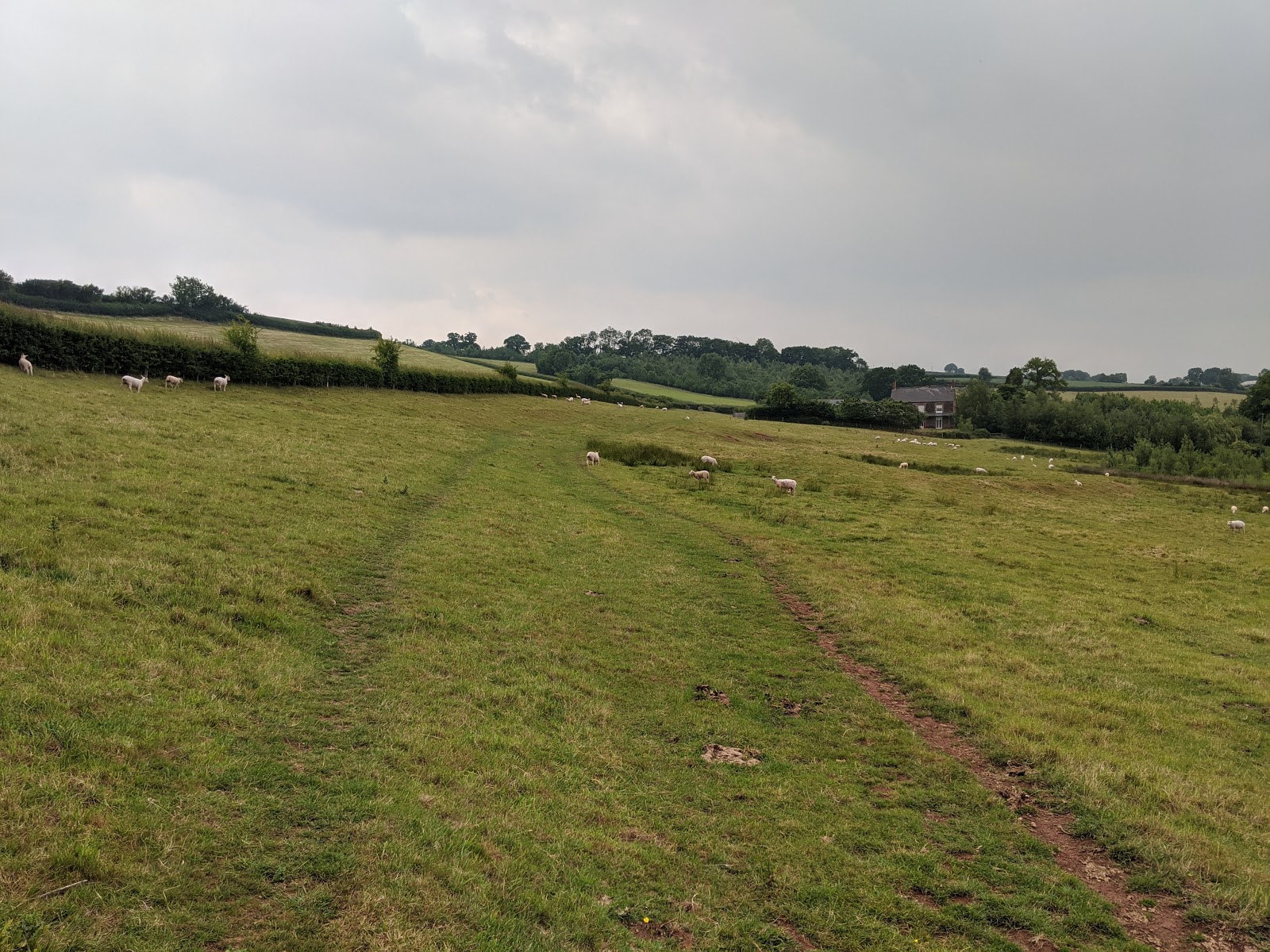
I don't know anything about this chap Garnsey except that he built a tower on the brow of a hill. This site suggests it is "a decaying tower in Blackborough woods that served as shelter for whetstone miners" which is not ever so revealing. Whetstones are used for sharpening tools and can be a variety of rocks, and I didn't see any evidence of mining. But the tower served as a focal point for the run-cum-hike barefoot which included several major footpath segments.

15.2 miles, 657m height gain, 4.2 mph

Detail showing some footpaths...

The work of an enterprising houseowner in Kentisbeare

It was a simple circuit in Gauge 1 and working too

Checkerboard church tower, Kentisbeare

Thatch is picturesque but that's about all

The ascent to Blackborough Common

My first footpath got dicy here - it was not well kept

But it resolved into a much better path

The roof of the ruin of Blackborough House

And finally, Garnsey's Tower, ruin thereof

From this angle, clearly a tower that once was

The views looking north from this part of Blackborough Common were spectacular. You can of course enlarge the pictures by clicking on them, after which you can scroll through them.


Large toadstool I noticed on my descent

The second major segment of footpath was also poorly maintained. According to my GPS enabled maps (I use UK OS and OpenTopoMap via MOBAC on OruxMaps) the footpath led me through the middle of an oil-seed rape field and then...


...through the middle of a wheat field (or some such grain) - I followed a line made by a tractor to minimise any additional damage to the crop, but in any case going barefoot does a good deal less damage than when shod because one feels one's way through the stalks.  And then...


...through a grassy meadow where I could actually run...


... and through hard to identify gates or styles to the next field or, in this case to...


... a very muddy and dark lane that finally opened up into the village of Ashill where there was a helpful sign telling me the lane was "not surfaced", and thence to...


... Culmstock and my much traversed water-meadow footpath to Uffculme and home. And (sadly) one tick so far.

20200614

Beauty or the Beast?

Yesterday in London.


It is now Sunday morning: I am sitting here, quiet and alone, in great-grandma's lounge listening to Rachmaninoff portrayed by Александр Малофеев with conductor Kristjan Järvi: such beauty, such wonder, such rendition, their interaction, their humility yet expertise. Albeit my tinnitus always there, a constant reminder of mortality so evident behind quieter passages.

Rachmaninoff second piano concerto

All his concerts have been cancelled or postponed as Alexander is currently unable to perform because of coronavirus lockdown, yet protestors in their thousands are ignoring social distancing. How is it even possible for two such extremes to voluntarily coexist on this planet? Who are these people flouting law and order, killing, maiming, destroying, as if that were valid compensation for exacerbated police brutality the other side of the globe? Have they not yet discovered joy, beauty?

And yet even in a concentration camp the birds sing.

Trooping the Colour


Looking good at age 94 and 99 respectively

We are at great-great-grandma's where the TV rules the day, and have just finished watching the Queen's official birthday Trooping the Colour at Windsor Castle. It brought back memories of school days. Once a certain age all pupils, unless with good reason, had to choose to be an Army, RAF or Navy cadet and play soldiers every Friday afternoon thereafter. I choose the RAF. Most of the time we were square bashing but there was some desk work - I remember learning about the Bernoulli principle and lift. I still have a certificate from an exam we took - I'll dig it out when we get home. On one occasion the NCO giving the lecture asked the class if we knew what "info" was. Bloody information he shouted, as if that was a peculiar revelation.

Every term there would be an outing. We came to school in our cadet regalia and bearing a packed lunch and were whisked off in a hired coach to our mystery destination, often a military base with real soldiers. On one such occasion I got to fly in a chipmunk. On another we went up in a cargo plane with no windows so one wonders what the point was. We had our own firing range using .22 rifles where I seem to remember I did better than average: on one outing got to fire a .303 and experienced its considerable kick-back.

Once a year there would be a General Parade over which a visiting top-notch would preside. It meant standing for hours on end waiting for things to happen. Usually one or two cadets would faint during this ordeal and this added a bit of interest to the otherwise dullness.

John Ashurst with Duke of Edinburgh 1965

One year the top-notch was the Duke of Edinburgh. He arrived by helicopter, landing in the playing field, and that was sufficient novelty to mark the event in our memories. So we did the general salute and march past thing, like in the Trooping the Colour, in which you marched forward whilst facing to the right and saluting. And then back to standing at attention in our ranks whilst the Duke did his rounds, stopping every so often to ask some boy an inane question. And I fervently hoped that he would not stop in front of myself. The same sort of feeling as in pass-the-parcel with forfeits, or that ridiculous party game where you have to dress up and eat a bar of chocolate with knife and fork, chocolate the previous folk have slobbered over...

20200612

The good and the not so good


OK, I know this will be boring unless you happen to like barefoot running and happen to be in the area and happen to want a route recommendation. Or maybe I should set up a public database of barefoot friendly footpaths.

Day 1, about 10 miles

My first foray on this trip to Devon was to explore some promising looking footpaths I had noted during our previous visit. But they turned out to be not so good - through recently strimmed brambles, fields sown with wheat, and inquisitive cows.

Day 2, another 10 miles

After a day's rest, the footpaths in my second foray were very good. The footpath part of the run is shown in the detail below.

Day 2 detail

It starts just north of the village of Uplowman (lower left of the map). The name sounds strange until you realise that Lowman is a river, and Uplowman is located in its upper reaches.


The path follows the river (technically a tributary to the Lowman, and just a brook) valley and is carpeted with soft meadow grass.  But about here it started to rain. Running in rain is very pleasurable provided one keeps warm - and I had checked that the forecast was OK in that respect.


By now it was raining steadily and I worried for my Pixel 2, as the plastic bag "sock" I had grabbed wasn't quite long enough to cover its entirety. But it survived.  At Murley farm I misread the map a bit (by now it was raining heavily, making it hard to read the map) but soon figured out my mistake.


Here I am looking back at the misty rain-sodden horizon as I climb out of the river valley towards Whitnage farm where again I lost my bearings (by now the rain was sluicing, so that I had to pause in the shelter of a barn to read my map). Those cows were content to leave me be, BTW. I decided to ignore the last planned footpath and get back home a.s.a.p. before dying of hypothermia.


Finally back along the Tiverton Parkway cycle track where I passed the 15:30 up train from Exeter to London Paddington. Thence back home to a shower and cuppa and later an excellent meal of risotto à la Instant Pot thankyou Ali!

Definitely worth repeating, both the meal and the run!

20200611

Rhodes must fall


The day before yesterday thousands of people filled The High outside Oriel College to peacefully protest for the removal of the statue to Cecil Rhodes that adorns the frontage to the college. All this in the wake of the toppling of the statue of slave trader Edward Colston in an anti-racism demonstration in Bristol, one of many in the UK sparked by the death of George Floyd while he was under arrest in Minneapolis in the United States last month. The statue, which will probably end up in a museum, has since been retrieved from Bristol harbour early this morning - the absence of protesters that early in the day itself says something.

Cecil Rhodes statue, Oriel College

Quoting, the frontage ...displays a statue of Rhodes himself, under a shell canopy propped by barley-sugar columns. At his feet a relief inscription reads E[X]: LARGA: MVNIFICENTIA CAECILII:RHODES, ie 'Out of the splendid generosity of Cecil Rhodes', the raised letters (here in bold) forming the laborious chronogram LMVIICICILIID (ie, reshuffled, MDCCCLLVIIIIII, ie 1911). the date when the building was completed.

The Rhodes Building owes to the initiative and generosity of Cecil Rhodes, intermittently an Oriel undergraduate between 1873 and 1881, whose £100,000 legacy included £40,000 'for the extension to the High Street of the college buildings': £22,500 was to be for building, the rest to replace income from tenements to be destroyed.

Four years ago there was a similar hue-and-cry to have the statue removed, and then it was apparently quashed when furious donors threatened to withdraw gifts and bequests worth more than £100 million if it was taken down.

The whole business is ridiculous IMHO. Firstly, in order to be consistent, if the statue is to be removed the inscription must also be erased and, indeed, the whole building ought to be demolished as it was built with funds supplied by Cecil. Secondly my own education owes itself in part to Cecil's generosity - in my first year I lived in the Rhodes Building, I came up to Oriel on a scholarship, not the prestigious Rhodes scholarship but it was probably funded in part by the Rhodes' legacy. History is history and should ideally be presented as both truthful and unbiased - yes in retrospect slavery was wrong, yes the holocaust was evil, yes both black and white and any other colour of lives matter and yes I owe my wonderful Oxford experience and its positive effect on my life in some small part to the generosity of a historical figure who represented white supremacy and was steeped in colonialism and racism. Does this make me culpable?

Floreat Oriel!

20200602

Post apocalyptic

The plan view of a vast post-apocalyptic city. Two types of living cell - the larger for those who grow food, the smaller for technology, industry. Pale blue indicates dwellings, whilst communal facilities are in orange. Dark blue is dense vegetation that provides oxygen and also hides an impenetrable fence. A network of fast one-way "roads" provide transport for the industrial areas, but no such transport exists or is required between the farming cells. Although there are tunnels that connect industrial communal facilities with their farming counterparts, generally the farming types do that and only that and never meet the industrial types. But there is relatively free passage from one industrial cell to the next, and one farming cell to the next.  These connections are clearly visible in the plan view.

Each cell houses perhaps as many as 100 human souls - the dwellings are generally extended family units, thus 25 per farming dwelling, but more individual industrial dwellings to promote creativity.

I know all this because I have spent hours poring over these plans and thus deducing what life was (or more to the point will be) like, and wondering how I might have extricated myself from the implied strict regime.


Actually the "plan" is the bungalow dining room table cloth...

Inverted bicycling

I had to wait until my 11'th birthday before my mum and dad bought me a bicycle. We went to a bicycle shop in Winchester - in Jewry Street I think it was - and I chose one that was yellow (my favourite colour) and black, with 3-speed Sturmey Archer gears. I loved that bike. I took it to Oxford where bikes rule the day - on one occasion I left it locked to some railings whilst attending a lecture and on returning found that some joker had stolen the lock and left the bicycle!  Sadly the bike was stolen when, later, I was living in London.

But in the days of my innocence, one summer's day (I can still picture it in my mind) I was on one of my bike jaunts and I thought - what about crossing my hands so that my right was on the left handlebar and vice versa?  It was amazing how quickly I lost control and ended up in a bed of stinging nettles much to my chagrin.  I was reminded of that experience when I stumbled across this video:


A similar experiment in which the subject has to wear lens that invert his vision 24/7 has been repeated several times.  I first saw it in a Fact and Faith film "Windows of the Soul" - forward to about 13 minutes if you're interested.  Occasionally put on by this or that church, I would implore my parents to take me. Remember there was no TV in our home back then, and of course no Google. In our enlightened internet age they seem rather cheesy but back then they were cutting edge. At least, I thought so.


The moral? Perhaps I should have persevered with riding with cross hands? Or is this post just another peep into my childhood - the strange boy who only borrowed science books, especially those about electricity, from the public library, whilst my older sister would choose novels. Who would spend hours in his "workshop" disassembling old radios and TV's and, occasionally, actually constructing something out of the bits.

Never dampen creativity!

20200531

Angel

Some while ago I posted about an XY-plotter I made. In fact it had a Z dimension in that it could lift the pen off the paper. The X direction was a platen roller. The Y direction was the pen carriage travelling along a true steel rod which I had salvaged from somewhere, about 12mm diameter, mounted over and parallel to the platen. I wanted a key-way slot milled down the length of this rod, into which the pen carriage was keyed so that by turning the rod the pen would lift.

On discussing my plan with my father he arranged a visit to an "angel" who, if my memory serves me, lived at Ovington House. I think this man ran a 5" gauge (or thereabouts) railway in his grounds and was one of my father's business clients, but I cannot find any reference to the railway in Google. In any case he, who must have been an angel, led us into his workshop where he had a milling machine. After I had explained what I wanted and why, he set the machine up and, wonder of wonders, told me to work it. Meanwhile he turned down the end of a small bolt that would follow the key-way. After profusely thanking him, he asked me to show him the plotter when I had completed it. That action I never took, and I live to regret it.

According to Google, the "angel" was Harvey Hoare of Hoare's bank. Whether so or not I remember one anecdote - my father told me the man would take micro-naps during the day, sitting in his chair, during which he would be totally non-communicando but after a few minutes would wake and be fully attentive.

The aerial view below might be Ovington House and the outbuildings arranged in a triangle strike a small chord in my memory - we had to walk outside to get to his workshop. And there are extensive grounds which could have housed a miniature railway.


Ovington House


Young Theo here wanted bits of wood which I gladly supplied. I asked him what he was making - it was, I think, "something to fire corks". I too would have loved to see his completed article working. Not because I want to see some inferior childish construction, but because I'd love to further inspire Theo's creativity. Like my grandfather once did who watched my disappointing attempts to make things and took me aside and helped me make a small wooden box that actually had at least a suggestion of precision and purpose.

The moral? Be an angel - facilitate but never discourage a creator-in-the-making.

20200529

The physiology of barefoot running

A short note for would-be Barefoot Runners and Others.

I get cracks in my feet and hands when my skin is dry. I had had an irritating but not deep crack in my right big toe for several days before my Table Mountain adventure, and because of it I toyed with whether to go or not. Hence the green/yellow insulation tape "plaster" in the photo of my feet, and that was the second application (I carry a roll with me on such jaunts). The next time I looked down at my feet the "plaster" was gone, and yet I didn't feel any discomfort, so it remained so until I got back home.  But after a cup of tea and a long shower, the irritation returned.

Similarly, sharp stones are always uncomfortable but one survives... but if I pause for a drink or a rest, when I set off again, almost however short the pause, my feet complain overly for the first few minutes, and then they largely appear to give up complaining.

It's as if the body adjusts - what used to hurt becomes just mild discomfort, by sheer necessity I suppose.

This principle should be an encouragement to would-be barefoot runners or, indeed, to anyone anticipating an activity that would seem nigh impossible.  Persevere. The human body is an amazing machine and it will do its utmost to keep you safe.  Of course there are limits, but most of us rarely meet let alone exceed those limits.

20200528

Lobawn and Table mountain


The mountain part highlighted in orange

Today's challenge was to go beyond Lobawn. The path that I transversed last time will take you from the village of Donard all the way to Lugnaquilla, the highest of the Wicklows. I didn't get that far, I turned off the beaten track at the summit of Table Mountain, thence to Three Lakes (actually there are only two), Arts Cross, a small segment of St Kevin's way and then back via the lane behind Knockalt.

Statistics: 24.2 miles, 3.7mph, elevation gain 1266m. My longest trek barefoot yet. Not that I was jogging all the time.  

The mountain part was awesome and definitely worth the toil, even if the return road work was hard going.  I took with me a small lump of cheese (Ali's idea), two eggs (Cadburys) and 600ml of water. I asked a householder for a refill on the way back and was glad that I had. It was a hot day.

If you are not too bored to check my photos (remember this is my blog and I do what I want, and I want these photos as a record and aide memoire of my ordeal) you'll see that the War Dept pillar on Lobawn is not the only one. In fact they turn up at other Wicklow summits apparently. They must have had a lot of them to get rid of after the war. And that mud (boggy peat) is hard to avoid and in any case is sort of irresistible and I reckon helps combat sunburn. Numerous dips on the descent helped to remove the evidence (in case any fellow-hiker might think I was mad - but I met not a soul on the mountains, all of them to myself). But I still needed a long shower when I got home.


Looking back to a Very Muddy Spot

Lobawn ahead

Looking back at Lobawn, another granite marker


Another granite column

Table Mountain in the distance

Yettanother granite column


Summit cairn, Table Mountain

Lugnaquilla in the distance

Our lake, from Table Mountain

Three Lakes from Table Mountain

Green goo in the "dike" from Table Mountain

More of the "dike"

The larger of the two Three Lakes

It was shallow and stony - I declined to swim


5 minute break for lunch in a sheltered spot

Art's Cross in the distance

Art O'Neill's Cross


Starting the steep descent from Art's Cross

The memorial at the base of the steep descent

Looking back at the steep descent

I took a dip in the Glenreemore book

Same

St Kevin's Way

Another dip, this time in the Kings river