My father used to say that the prototypes for all the best stories in the world can be found in the Bible. I have always considered this a rather far claim - but then I conceived this blog.
I have just finished reading
Kim for possibly the third time in my life. In my opinion a blog should be as honest as one can reasonably get in public, so I will say that I love the book. Or is it Kim that I love?
Kim's gun Zam Zammah in front of the Lahore 'Wonder House'
Right from
"He sat, in defiance of municipal orders, astride the gun Zam Zammah on her brick platform opposite the old Ajaib-Gher--the Wonder House, as the natives call the Lahore Museum. Who hold Zam-Zammah, that 'fire-breathing dragon', hold the Punjab, for the great green-bronze piece is always first of the conqueror's loot" I want Kim, fatherless and to all intents motherless and homeless, to succeed in life. Sorry, that sounds so lame, but I do not know how to express my feeling any better.
The book ends with the lama who "
crossed his hands on his lap and smiled, as a man may who has won salvation for himself and his beloved." Though Kim sometimes calls the lama "mad", unlikely a relationship though it may be, each is totally committed to and loves the other. And, to a lesser degree, it could be said that
Colonel Creighton, Babu and Mahbub Ali love Kim. Although Kipling paints a poor picture of the two clergy who want to convert him, the lama never inflicts his religion on Kim and Kim never despises the lama on account of his "mad" beliefs.
I think that Kim is an idealisation of Kipling's son John (Jack) who a few years old when the book was published. The strong love Kipling had for his son, lost in WWI, is well expressed in:
“Have you news of my boy Jack?”
Not this tide.
“When d’you think that he’ll come back?"
Not with this wind blowing, and this tide.
“Has any one else had word of him?”
Not this tide.
For what is sunk will hardly swim,
Not with this wind blowing, and this tide.
“Oh, dear, what comfort can I find?”
None this tide,
Nor any tide,
Except he did not shame his kind —
Not even with that wind blowing, and that tide.
Then hold your head up all the more,
This tide,
And every tide;
Because he was the son you bore,
And gave to that wind blowing and that tide!
Some people seem to want to label any love expressed between men as blatant homosexuality quoting, for example, the powerful and loaded words "it was here, about sunset, that they came across an aged lama... sitting cross-legged above a mysterious chart held down by stones, which he was explaining to a young man, evidently a neophyte, of singular, though unwashen, beauty." I strongly oppose this as far as Kim and my other examples, all beautiful in their own way, are concerned.
We recently watched
Australia and of course all fell in love with the boy Nullah (for what it is worth it took me a while to realise that he was not a girl...)
Then there is
Le Petit Prince. Who can fail to appreciate the bond of love between the author and this boy, the strong desire to see the boy succeed, who ends up dying in order to live?
There was nothing but a flash of yellow close to his ankle.
He remained motionless for an instant.
He did not cry out.
He fell as gently as a tree falls.
There was not even any sound, because of the sand.
Regarding the author you might be interested to check out
this and
this.
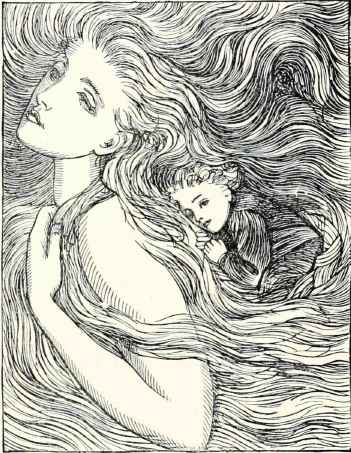
Another favourite of mine is Diamond in
At the back of the North Wind who is likewise fragile, but greatly loved, and likewise dies in order to live.
"Fourdays after, I called again at the Mound. The maid who opened the doorlooked grave, but I suspected nothing. When I reached the drawing-room, I saw Mrs. Raymond had been crying. "Haven't you heard?" she said, seeing my questioning looks.
" 'I've heard nothing,' I answered. 'This morning we found our dear little Diamond lying on the floor of the big attic-room, just outside his own door—fast asleep, as we thought. But when we took him up, we did not think he was asleep. We saw that-----' "
"Here the kind-hearted lady broke out crying afresh.
"" May I go and see him?" I asked.
""Yes," she sobbed. "You know your way to the top of the tower."
"I walked up the winding stair, and entered his room. A lovely figure, as white and almost as clear as alabaster, was lying on the bed. I saw at once how it was. They thought he was dead. I knew that he had gone to the back of the north wind."
In all these stories the theme is of a boy, always a boy, who is helped through the perils of the world by great, fatherly love.
Luke 15 has "
Now the tax collectors and sinners were all drawing near to hear him. And the Pharisees and the scribes grumbled, saying, 'This man receives sinners and eats with them.' So he told them..." three parables, the third being the "Prodigal Son", the point being that the Pharisees were the older son who could not accept his renegade brother being accepted back into the family, but Jesus carefully shifts the emphasis to the younger boy. Once again we have a boy helped through the perils of the world by the great love of his father. But we haven't got to the prototype yet. This parable is one of the most poignant stories to describe the love of God for his sons, a love that reaches down to the depths of man's depravity. That is the prototype I believe Kipling and Antoine de Saint-Exupéry (possibly unwittingly), MacDonald and others are echoing, and that is why this, the greatest story, continues to touch our heartstrings.