Showing posts with label kim. Show all posts

20160823

People who love their lives do differently


Irish cows (I suppose)

Two things from a web site entitled "10 Things That The People Who Love Their Lives Are Doing Differently":

 - They do things because they want to do them, not because they believe they have to do them.

 - They don’t bother changing others, but instead learn how to deal with them appropriately.

Differently? For me I think not, and neither were any of the other eight any surprise. And yet I still find myself often dancing to another tune. But who is the piper?

Is it when I don my Christian hat? Not that I ever take it off - I just think about taking it off. A bit like Kipling's Muslim Mahbub Ali 'So says my Law--or I think it does'. I wonder what God wants of me and to what extent I should "be faithful" to those I fellowship with. Hmm. Like what would Jesus do? Not that I would ever wear one of those bracelets. I abhor anything unnecessary being attached to my body. And, no, I do not have a wedding ring - I don't even wear a watch unless it is the GPS variety and then only for a short period. So does that make me a hedonist? Or an ascetic?

Christians are often accused of thinking it is somehow wrong to enjoy oneself. Something to feel guilty about.  This quote from Chelsea Handler, who doesn't come across as a God seeker herself, sums up the absurdity nicely: "I think only hedonists believe in God, in the same way that I think only hedonists have babies."

Then there is the Buddhist's "middle way" a path of moderation, between the extremes of sensual indulgence and self-mortification which sounds to me a bit like a cop out.

My drainage canal on the lake shore

Joining the ponds to the lake proper

So is it wrong to make canals in the sand at my age? Or to run barefoot imagining I am a locomotive following a well graded permanent way along the lake shore, carefully choosing places to cross gorges and chasms hundreds of millimetres deep carved out over the eons by surface run-off. Or messing in mud. Or taking random photos of cows whilst I am on a run. Or posing for ridiculous shadow selfies. All on my own. Or, on a slightly more serious note, randomly improvising on the piano, or humming a favourite tune in parts. Combining colour filters in a search for the ultimate hue. Maintaining a blog that few read. Or, as the song goes, climbing mountains or jumping in a lake. Enjoying a Cherry Bakewell. Is it not possible to praise my Maker in such things? Rather than being restricted by accepted evangelical/charismatic liturgy and the paraphernalia that goes with it?


A random stock photo - not me, but it might have been

Looks like it runs in the family...

And this is me - yet again!

We non-conformists watch Catholic or high-church antics with mingled horror and disbelief, and yet how much of what we do is likewise mumbo-jumbo to the average agnostic? Lord save me from doing things just because some implied rule book tells me I should. But on the other hand Lord save me from only ever doing things just because I want to. There has to be a better reason, like "hath God said?". But I wonder just how much He does say and then, in the absence of such direction or other constraints like "love thy neighbour as thyself", why not enjoy life: abounding as well as sometimes being abased?

Here's another thing. I'm not good with words. Hence this blog as being just possibly a better way for me to communicate. Typically I will re-read and make changes to a longer post like this one many time and over many days, a degree of freedom one does no have with speech. And besides, when speaking, especially in public, I often fail to get across the very point I set out to make. In an argument the other person can easily walk all over me. When I was very young I was given speech therapy and they said I was lazy. With worship songs that we sing, I know the music but often cannot recall the exact words. I do not believe I have ever written poetry and am probably incapable of it. It is not that words have no meaning for me - I marvel when I read a book that is (IMHO) well written and I have even been known (though rarely) to appreciate poetry. I am a slower than average reader and am intimidated by small print or excess or flowery description. What interests me in a book or a film is believable fantasy, portrayal of character, the set, and music - more than plot - and if I identify then I long to know what happens to the protagonist (or the actor) afterwards.

I prefer emails to telephone calls. I will do almost anything to avoid the latter. With an email there is at least the chance to make changes before pressing the button. But I know folk who are quite the reverse and sometimes we don't meet.

Why am I saying this? Because the liturgy and paraphernalia I mentioned above is so bound up in words and, where does that leave those of us who struggle with speaking? - I have noticed how such people easily get side-lined. Because so much value is placed on words.

My work involves programming. Writing assembler for a RISC processor is great - there are only about 50 instructions to remember: I can memorise that many and then I am in total control. Assembler is simple and deterministic. An op-code such as "incf 23" increments the value in memory address 23 and takes exactly one machine cycle to execute. At the other end of the extreme a language like C# is very verbose and maybe few programmers know all the vocabulary it offers. C# is very clever and, given such knowledge, enables you to do very smart things with just a few lines of code, but don't expect a known result in a known amount of time! I am not comfortable with programming in C# because I can't remember all those words and thus feel out of control.

Granted that the Gospels are more about Jesus but you'd think they or maybe Paul's epistles would mention his disciples - but for most of them there is little or no record of what they said or did. Simon Peter is of course the exception. And yet I suppose the rest of them were chosen for a reason. Take Matthew - we suppose he wrote the gospel bearing his name and yet there is no record of what he did or said in the whole of the NT apart from the fact that he was a tax collector and followed Jesus immediately when called.

One other disciple in particular comes to mind. Dear Thomas, pragmatist to the end. I say "dear", of course, because I identify with him.

In the four very obviously ordered lists of apostles (Matthew, Mark, Luke and Acts) he comes half way - neither most nor least noteable. His three other mentions are all in the gospel of John.

Dean Jones in John on Patmos

In chapter 11 he makes a possibly snide remark which Adam Clarke comments well on. In chapter 14, whilst Jesus is explaining spiritual truths in somewhat mysterious language, he interjects "we haven't a clue what you're talking about so how can be possibly know the way?" And finally, post resurrection, we have Jesus appearing to and showing his hands and side to the disciples, but Thomas happens not to be there. On catching up afterwards he remarks indignantly "Unless I see in his hands the marks of the nails and place my fingers into his side, I will never believe" which Dean Jones impersonates rather well in his John on Patmos. Dear Thomas. I hope I would have done the same, for I'd certainly have thought it. Maybe the more "spiritual" among us might despise him (and me) for lack of faith - such folk might consider themselves spiritual but I think they do not understand the word.

Eight days later, Jesus (though the doors were locked) enters and announces himself with "Peace be with you" and in the very next breath, wonder of wonders and never mind the other disciples there, he says to Thomas "Put your finger here, and see my hands; and put out your hand, and place it in my side." No ticking off, no putting down, he meets Thomas just where he is and supplies just what he needs to evoke his response "My Lord and my God!"

Martyrdom of St. Thomas, by Peter Paul Rubens

Wanting, as always, to know what happened to the protagonist, I did a bit of research and found that there is good reason to believe that Thomas later traveled to India where he preached the gospel and was martyred. Less certain is the tradition that he was killed by a sword being thrust into his side.

In this short life that we live there is a whole lot more than talking.

20160609

Three books


Seminary boy is an autobiography of a boy whose father is somewhat dysfunctional who, at age 13, is "called" to the priesthood and endures "arcane masochisms and bizarre prostrations that only a Catholic can fully appreciate". At minor seminary he discovers class mates who are homosexual (though is not himself) and one priest-teacher even tries to seduce him. Graduating to senior seminary it all becomes too much and he renounces his faith, settles down to married life, only to later return to Catholicism. I was surprised at this return after all he had suffered, but he elegantly notes that What we are escaping is not God at all, but false representations, the 'trash and tinsel', as Yeats once put it, that pass for him. So, 'hatred of God may bring the soul to God'.

I well know this "trash and tinsel". Maybe I am becoming too cynical, too judgmental in finding more and more difficulty in singing certain Christian songs with any conviction. The Jesus I read about in the gospels seems distant from some of the slush that we sing.


There has been much and well deserved exposé recently of the sexual abuse of children, examples being made of Catholic priests. A side-effect is that we have become paranoid: youth workers now needing police clearance, parents nervous about ever leaving their children unattended in public places. Characters like Rupert Bear, who has free and often solitary reign of the whole of Nutwood, are clearly no longer PC.


The second is that old favourite, Kim which begins evocatively He sat, in defiance of municipal orders, astride the gun Zam Zammah on her brick platform... Later Kim, an orphan, is described as a young man, evidently a neophyte, of singular, though unwashen, beauty. And the book ends likewise evocatively with the lama who crossed his hands on his lap and smiled, as a man may who has won salvation for himself and his beloved.

And along the way the horse dealer Mahbub Ali tells: 'Thou art beyond question an unbeliever, and therefore thou wilt be damned. So says my Law--or I think it does. But thou art also my Little Friend of all the World, and I love thee. So says my heart;

and the lama: 'A blessing on thee... I have known many men in my so long life, and disciples not a few. But to none among men, if so be thou art woman-born, has my heart gone out as it has to thee--thoughtful, wise, and courteous; but something of a small imp.';

and Kim himself, who had loved him [the lama] without reason, now loved him for fifty good reasons. So they enjoyed themselves in high felicity, abstaining, as the Rule demands, from evil words, covetous desires; not over-eating, not lying on high beds, nor wearing rich clothes.

Of course, you say, Kipling lived in a different age so would not have written anything sexually explicit. Some say that Kipling was gay. I say that he was an honest man and would have written no differently today.

A man's sexuality cannot be isolated from the rest of him and, so they say, men think about sex once every 7 seconds. I do not mean to imply that Kipling's characters had no feelings but rather that they were very human, just as I am. And that is what endears the book to me. Can it not be that the lama and Mahbub Ali loved Kim, period? As a father loves his son, if you will? A friend of mine, when I suggested that his daughter was dressing provocatively, told me that it was I who had the problem. Is that the only solution to the equation? What marks a "gay" man is that he has chosen to let his sexual feelings manifest in a particular way. I cannot say whether some men may be more inclined in that way or not, but I do know there is at least a degree of personal choice involved.

The third book, which I have not yet finished, is also about a boy whose father is dysfunctional, and it is written from the perspective of a family friend who recognises the boy's plight, loves him and tries to get involved but is met with rejection at every turn and is even accused of homosexuality. And, forever after, he is left wondering who was right.

20160531

Morning splendour


Early morning splendour. Who can resist running barefoot along this shore on a day like this, enjoying, with Christopher Robin and Kim, the sand or mud between the toes, taking a refreshing dip? And yet I had the whole beach to myself.  See also here.


20120708

The greatest story

My father used to say that the prototypes for all the best stories in the world can be found in the Bible.  I have always considered this a rather far claim - but then I conceived this blog.

I have just finished reading Kim for possibly the third time in my life. In my opinion a blog should be as honest as one can reasonably get in public, so I will say that I love the book.  Or is it Kim that I love?


Kim's gun Zam Zammah in front of the Lahore 'Wonder House'

Right from "He sat, in defiance of municipal orders, astride the gun Zam Zammah on her brick platform opposite the old Ajaib-Gher--the Wonder House, as the natives call the Lahore Museum. Who hold Zam-Zammah, that 'fire-breathing dragon', hold the Punjab, for the great green-bronze piece is always first of the conqueror's loot" I want Kim, fatherless and to all intents motherless and homeless, to succeed in life.  Sorry, that sounds so lame, but I do not know how to express my feeling any better.

The book ends with the lama who "crossed his hands on his lap and smiled, as a man may who has won salvation for himself and his beloved." Though Kim sometimes calls the lama "mad", unlikely a relationship though it may be, each is totally committed to and loves the other.  And, to a lesser degree, it could be said that Colonel Creighton, Babu and Mahbub Ali love Kim. Although Kipling paints a poor picture of the two clergy who want to convert him, the lama never inflicts his religion on Kim and Kim never despises the lama on account of his "mad" beliefs.

I think that Kim is an idealisation of Kipling's son John (Jack) who a few years old when the book was published. The strong love Kipling had for his son, lost in WWI, is well expressed in:

“Have you news of my boy Jack?”
Not this tide.
“When d’you think that he’ll come back?"
Not with this wind blowing, and this tide.

“Has any one else had word of him?”
Not this tide.
For what is sunk will hardly swim,
Not with this wind blowing, and this tide.

“Oh, dear, what comfort can I find?”
None this tide,
Nor any tide,
Except he did not shame his kind —
Not even with that wind blowing, and that tide.

Then hold your head up all the more,
This tide,
And every tide;
Because he was the son you bore,
And gave to that wind blowing and that tide!

Some people seem to want to label any love expressed between men as blatant homosexuality quoting, for example, the powerful and loaded words "it was here, about sunset, that they came across an aged lama... sitting cross-legged above a mysterious chart held down by stones, which he was explaining to a young man, evidently a neophyte, of singular, though unwashen, beauty." I strongly oppose this as far as Kim and my other examples, all beautiful in their own way, are concerned.

We recently watched Australia and of course all fell in love with the boy Nullah (for what it is worth it took me a while to realise that he was not a girl...)


Then there is Le Petit Prince.  Who can fail to appreciate the bond of love between the author and this boy, the strong desire to see the boy succeed, who ends up dying in order to live?


There was nothing but a flash of yellow close to his ankle. 
He remained motionless for an instant. 
He did not cry out. 
He fell as gently as a tree falls. 
There was not even any sound, because of the sand.

Regarding the author you might be interested to check out this and this.

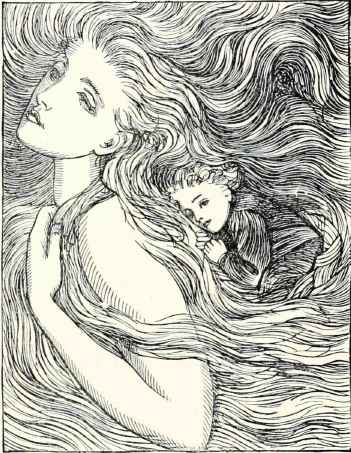
Another favourite of mine is Diamond in At the back of the North Wind who is likewise fragile, but greatly loved, and likewise dies in order to live.


"Fourdays after, I called again at the Mound. The maid who opened the doorlooked grave, but I sus­pected nothing. When I reached the drawing-room, I saw Mrs. Raymond had been crying. "Haven't you heard?" she said, seeing my question­ing looks.

" 'I've heard nothing,' I answered. 'This morning we found our dear little Diamond lying on the floor of the big attic-room, just outside his own door—fast asleep, as we thought. But when we took him up, we did not think he was asleep. We saw that-----' "

"Here the kind-hearted lady broke out crying afresh.

"" May I go and see him?" I asked.

""Yes," she sobbed. "You know your way to the top of the tower."

"I walked up the winding stair, and entered his room. A lovely figure, as white and almost as clear as alabaster, was lying on the bed. I saw at once how it was. They thought he was dead. I knew that he had gone to the back of the north wind."


In all these stories the theme is of a boy, always a boy, who is helped through the perils of the world by great, fatherly love.


Luke 15 has "Now the tax collectors and sinners were all drawing near to hear him. And the Pharisees and the scribes grumbled, saying, 'This man receives sinners and eats with them.'  So he told them..."  three parables, the third being the "Prodigal Son", the point being that the Pharisees were the older son who could not accept his renegade brother being accepted back into the family, but Jesus carefully shifts the emphasis to the younger boy.  Once again we have a boy helped through the perils of the world by the great love of his father.  But we haven't got to the prototype yet.  This parable is one of the most poignant stories to describe the love of God for his sons, a love that reaches down to the depths of man's depravity.  That is the prototype I believe Kipling and Antoine de Saint-Exupéry (possibly unwittingly), MacDonald and others are echoing, and that is why this, the greatest story, continues to touch our heartstrings.