Showing posts with label semaphore. Show all posts

20240615

2024 Foray #1 the Suir Blueway

As I remarked to my granddaughter, at her age the world lies at her feet, but at my age I'm thinking "can I even do this?" or " this may be the last time I get to..." But in good faith that the body the Good Lord gave me won't let me down yet, I set off for what must count as the first of my 2024 forays. The particular destination was the Suir Blueway bicycle path following the river Suir from Clonmel to Carrick on Suir and the railway linking Limerick Junction with Waterford.

Outward journey 

The foray started with a 5:15am departure by bike for Heuston station, Dublin,  where I boarded the 08:00 Cork service, changing at Limerick Junction to the branch line to Cahir.

Segment (1) to Heuston 42.4km


Changing trains at Limerick Junction

From Cahir I followed the wide, paved path along the river, past Swiss Cottage, until it ended abruptly. Here there is a short footpath to the nearby road, but very overgrown and full of stinging nettles. I survived.

beside the Suir, looking north towards Cahir

looking south towards Swiss Cottage

The blue-way

Forced to leave the river I fought my way to the road and biked to Clonmel (land of cider) where I joined the blue-way, so called because the river is navigable for canoes and suchlike, though I did not see any. But I did pass many walkers and cyclists on the nicely paved path. And folk fishing out in their waders - but the fishing in these parts is all private, some clubs having well appointed fishing shelters.

From Cahir to Clonmel

From Clonmel to Carrick along the blue-way, totalling 51.5km


Beautiful bridges

Orchards to feed the cider works

The paved blue-way

The tower

I had several hours to kill before my train, the only train, would return me to Limerick Junction, so after checking the whereabouts of the station (and finding it all locked up) I entered part (b) of my foray, destination De Le Poer Tower. This involved a steep climb of about 150m elevation gain over 1.5km out of the Suir valley and then another battle with undergrowth before emerging onto a forestry track beside the tower. The wonders of GPS!

16.6km there and back

Having emerged from the undergrowth...

Towards the Comeragh mountains

The top is obviously unfinished

Towards Waterford


The plaque is visible but not the inscription

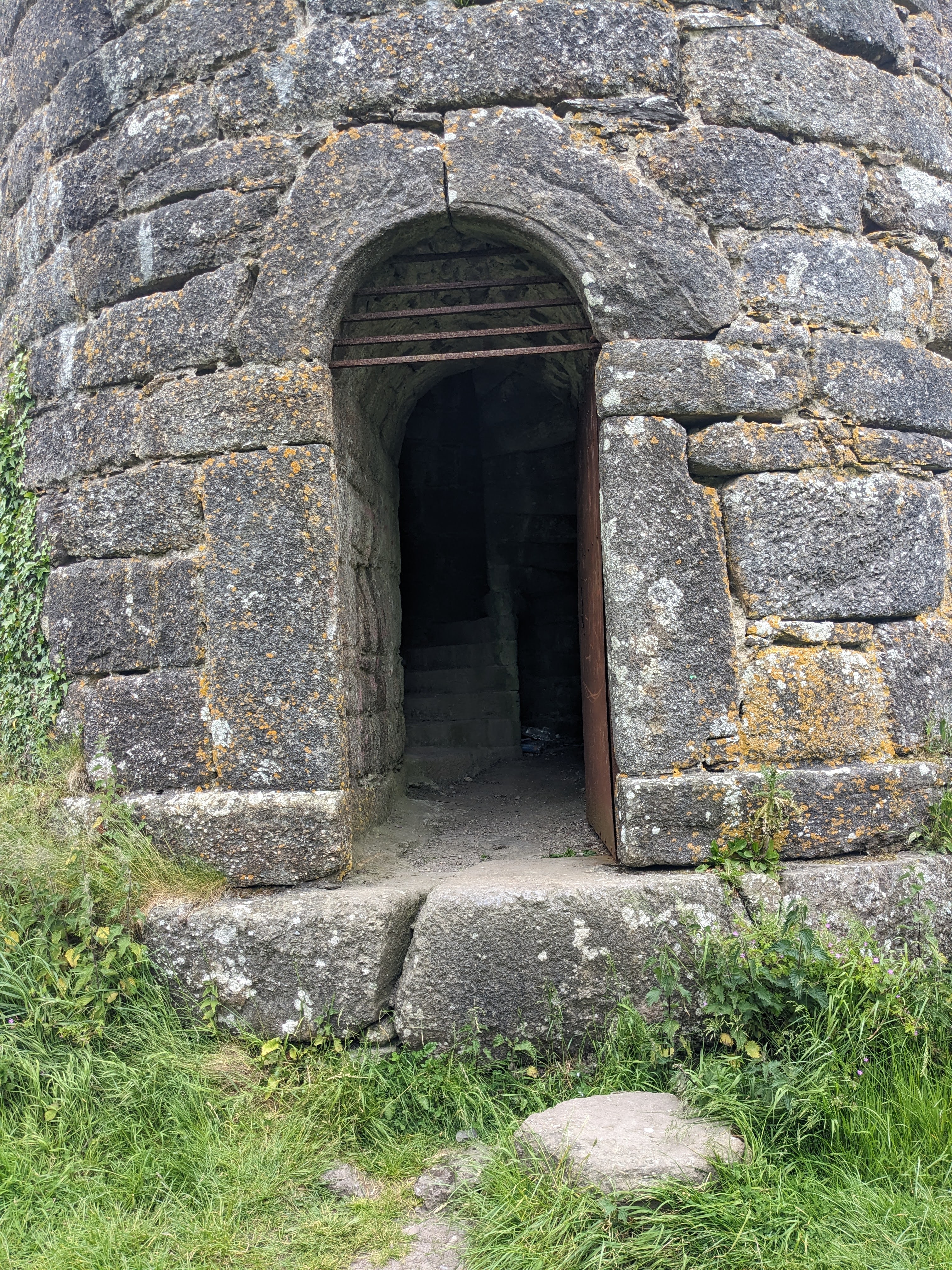
There is a steel door, but it was open

Much of the following is quoted from various internet sites

The De Le Poer Tower has a sad back story. It was built in 1785 by the second Earl of Tyrone, George de la Poer Beresford, in memory of his eldest son Marcus. We are told that the plaque above its door states that the monument was dedicated 'To his beloved Son, his niece and his friend'.  His son Marcus died aged 12 in a horse riding accident at Curraghmore. The 'friend' refers to his tutor Marcus, Charles Poliere de Botens, who died at shortly after the boy's death. It touched me that his tutor was also his friend.
Curraghmore is the estate and its big house is just visible in one of my photos. More sadness followed: the tower was planned to be 120ft high but was left unfinished at 70ft. Why? Maybe as a poignant statement of grief. Its unfinished look makes it even more special, like a symbol of a life that ended too soon; a powerful reminder of how precious life is and how memories last forever. Surprisingly in this age of safety first, the entrance is laid open and I climbed up the 92 steps to the top where the spiral staircase ends abruptly. There is no parapet or rail, nothing to stop the more adventurous from standing on the edge and falling. Indeed, at the base there is a recently erected wooden cross where, I suppose, someone lost their life that way. All very heart wrenching. But I had no time to commiserate: I had to get back to catch the one and only train. Hurrying down to the road, the undergrowth inflicting many bramble scratches on my legs, a further testament to the sorry story.


Curraghmore is the seat of the Marquess of Waterford. The estate was part of the grant of land made to Sir Roger le Puher by Henry II in 1167. One wonders on what basis Henry II could grant Irish land. Today it is the home of Curraghmore Whiskey, a 100% authentic, Single Estate Pot Still Whiskey, crafted from barley and oats grown on the estate.

My original intention was to go on to explore the estate's nearby church which I could see from the tower, and Mother Brown, a curiosity that you can do your own research on. Driven by an irrational fear of missing the train I let those historic items be and hurried back.

The tea shop

Mostly downhill, it took less time than planned to return to the railway station, indeed I discovered an error in my calculations: I actually still had over an hour spare. So I roamed the streets of Carrick in search of tea and found the unlikely named Sunnyside Café. Propping my bike against the neighbouring derelict property (Carrick is a bit run down) I was accosted by the proprietor who kindly coerced me into ordering a pot of tea and scone with butter and jam, for which I was eternally thankful. Who wouldn't be after peddling up that hill?

The railway

Then back to the station. It was still locked up, after all it serves only two trains in each direction every day. But eventually the signal man cum porter cum station master unlocked the gate and led me to a waiting room complete with electric heater.  I still had half and hour or so to wait so I familiarised myself with things railway.

Carrick on Suir station towards Waterford

Section signal protecting the level crossing

Signal boxes are still in use on this line

The level crossing gates are opened manually

home signal 'off' shows our train is on the way  

Gates closed to traffic and section signal 'off' 

Our train arrives at last!

One of our stops is this iconic placename

Having I suppose ascertained that the train is running on time and that the section ahead is clear, just before the due time of arrival the signal man descends from his box and drives his car the 200m or so to the level crossing. He manually closes the gate to traffic, then drives back to his box where he lowers the section signal to indicate to the arriving train that it is safe to proceed. He then climbs down from his box again, carrying the block signalling token to give to the train driver. By this time I am in the train, but doubtless the signal man communicates with the next box that the train has entered the section, sets the signal 'on' (stop), drives down to the crossing gates and opens them, then closes up shop and takes a well earned rest. Which melodrama all seems a bit OTT given that there is likely only one train set that trundles from end to end of the route.

On the return journey I noticed that there are a number of similarly manually operated level crossing on this line, complete with signal boxes, although I noticed that one crossing was automated with lifting barriers and colour-light signals protecting it. I suppose it warranted this special treatment because it was a busier road. 

Based on the appearance of the track (concrete sleepers, welded rail, clean ballast), Iarnród Éireann has obviously spent a small fortune on bringing the line up to standard so one wonders why so few trains each day and so few folk using those trains. I was surprised to find semaphore signalling, indeed the signals look brand new so I suppose they also were upgraded. And why the 80km/hr speed limit? I do hope the line stays open because I like branch lines. I went to school on one. But at present it surely cannot be economical. One blogger sums it up with "It is like spending a fortune upgrading a hotel but only opening on a Wednesday during the depths of winter".

Once again I managed to convey my bike from train to train at Limerick Junction and then again at Portlaoise catching the slow train that would stop at Sallins. Here I exited to cycle the last segment of my trip back home. A total of 131.9 km biking.

21.4km from Sallins to home

Wow, how I slept well that night!

20160513

Signals and relays


This web site describes UK signals both semaphore and colour light and is animated rather nicely.

When I was of school age I loved to join my father in the Railway Room typically on a Sunday afternoon. My mother was, I think, jealous of the time we spent there, and maybe of the money spent, so my father would disappear clandestinely. I would monitor his movements and thus figure where he had gone and join him sooner or later. And there we would stay until my mother called up the stairs "tea time". I think she visited the Room maybe once or twice, as did my sisters, but never with any particular any interest. In fact it was very rare to find anyone with similar interests.

Dad would habitually control the up line and I the down line. Neither of us were too fussed with the visuals although each of us had made a few half-hearted attempts at scenery. This is so different from the typical model railway display where visual authenticity rules ahead of technicality.  For us time and motion and the feeling of actually driving the train were more important. But this is all described in the previous post and all I want to add here is a more in depth description of the automatic signalling I added to the down line circuit.

Relay operated block signalling

I kept my original hand-drawn wiring schematic for many years but sadly no longer have it. Our community experience in the North was a great reducer of personal possessions. The schematic above (click to enlarge) is drawn from memory and may not be quite as I had it. I do remember I had to add electrolytic capacitors to slow down some of the relays, I suppose to avoid some sort of glitch happening, but I cannot remember where they were placed. I must have been that much wiser back then. But I think it will be sufficient for any other model railway signal-lover to base their design on, in the off-chance that such a one might read this. The scheme is of course based on the absolute block system which I had ample time to study on my daily journeys to and from school, in which only one train may occupy a given block or section of railway and the entrance to each block is protected by a signal and, if single track, by the occupying train driver having in possession a unique "token".

The 4-pole changeover relays were from an old telephone exchange. I may in fact have used 6-pole relays as one extra pole would save the latching effect relying on a resistor to keep just enough current to hold the relay closed. And the 6th pole could be used for four aspect signalling or added complexities such a junctions.

The 2-pole changeover relays I probably purchased. The single pole changeover "current sense" relays were hand made. At the time I was not aware that such a thing existed so I had to invent it.  A model train typically consumes between a quarter and one amp, so the idea was to wind sufficient turns on the coil to operate the armature whilst not reducing the voltage delivered to the train appreciably. The system worked superbly.

Later in life, after I had learnt about TTL logic, I tried reproducing the functionality with integrated circuits. This was unsuccessful for various reasons. I suppose now-a-days one would use a microprocessor. No - now-a-days most folk would not even bother and instead just get the "app".

It's strange reading Sci-Fi stories that date from the 1950's.  Sure, they have space ships and robots, but they are all powered by relays that click incessantly. And the people are smoking incessantly, even in space ships in outer space.  Having said that, relays are very much still with us being almost irreplaceable for many functions.  They are rugged - no problems with damage by ESD or finite on-resistance! Available with many poles. And capable of switching large currents and voltages.

The operative part of my scratch-built colour light signals were 12V grain-of-wheat bulbs which I purchased, as pocket money permitted, in the model shop in Eastleigh. This shop was tiny - a bit like the electronics shop in Winchester only the sales person was a woman if I remember correctly. Not that there is anything wrong with that: she knew her business well enough. In later years I made one using those new-fangled LED's but by then I was away at college so it was never used.

The second innovation was the automatic selection of one of two speed controllers (the "inertial" design described in my previous post). In this way it was possible to control two trains independently. The choice is controlled by the wire labelled "SELECT" which is 3-state: open-circuit leaves the next 2-pole relay in its existing state, connecting to +12V turns it on and connecting to 0V turns it off. A red signal opens the circuit thus preventing any new choice (set by the switch) to ripple through to the block beyond.

The schematic shows only 2 blocks - in fact there were 4 blocks in the overall circuit, not counting the station block itself which was controlled manually. Along the way there was a passing loop and two merging tracks which were also controlled automatically. The above schematic shows none of this detail.

Once I had designed the system I had to cut the track to create the dead section (to force the train to stop before a danger signal) and the sense section (to operate the sense relay) in each block, and run numerous extra wires under the base-board.  Cutting the rails was easy enough using a junior hacksaw, but I did it in much trepidation because I did not first ask my father's permission. This latter omission some might question but, in fact, it was done intentionally - it is a principle of life that the adventurous must "boldly go where no man has gone before".  I find it is the same now with my running hobby - I don't tell people in advance what I am about, I hardly dare even mention it to myself - for fear of disapproval. The principle only works, of course, if it works. I knew my father well enough to figure he would not be overly displeased provided I proved myself. Witness the episode when, much younger, I carved up the lawn. Any parent who stifles their kid's creativity needs their head testing. I guess there are limits, though.

Signal symbols

I invented these symbols to represent signals for track diagrams - the top row are colour light and the lower row the equivalent semaphore.


Signal box at Alresford

If I ever travel by rail my head is often out of the window (modern trains don't facilitate) - and in particular I am looking for the signals. Why signals? Doubtless because of their colour, and figuring out the necessary underlying control systems. Which of course implies my fascination with the signal box with its token system at Alresford where I boarded the train to school every day. My father introduced me to Mr Norris the signalman on one occasion when I got to see the inside of the box.

I found the pictures below on the internet - they date back to my school days.  I caught the 08:15 train every morning and often arrived (panting) at the station after the two trains had pulled in, to run along the platform and over the level crossing to the down line on the left. The picture brings back so many memories, mostly fond.


Up and down trains passing at Alresford

The route passed through Itchen Abbas station (this station was unattended and its passing loop had been removed many years before my time) and thence to Winchester Junction where it joined the main line from Waterloo.  Here the signal box was equipped with a platform where the signalman would wait to collect the token from the driver (or give it him on the return journey).

Passing the token at Winchester junction