Showing posts with label kenya. Show all posts

20180901

Lost confidence


Stock image - close up of a child's eyes looking sad

Nauru, the island where children have given up on life. Where children as young as 10 are self-harming and committing suicide. These people have lost their confidence - how can this be allowed to continue in our world today?

Whilst we were away visiting folk in the UK a visiting preacher here talked about confidence.

Confidence... The good book says "Therefore do not throw away your confidence, which has a great reward. For you have need of endurance, so that when you have done the will of God you may receive what is promised." I picture a young person full of ambition working their way to the top of their profession. But it also says that we should "put no confidence in the flesh" so maybe my picture is all wrong!

Growing older... in one sense I am still me, I don't feel any different. But my senses and memory are not so astute and I get tired more easily. And above all I am in jeopardy of loosing my confidence. Confidence in being a good husband, a good father (though mercifully my children can now look after themselves, maybe soon they'll be looking after me, God bless them), confidence in being a supposed Christian leader, a teacher, even in being an electronics design engineer and programmer. And sometimes I just feel like giving up. But I know I mustn't. And compared with these children on Nauru, or the Kenyan kids my daughter is teaching, or indeed 90% of the world's population, I have it made living here. How dare I have such negative thoughts? And yet I do: because there is some truth in the lack of my abilities which, I suppose, I must come to terms with.

I now (sometimes) use a hearing aid, I wear glasses for reading and, more recently, for driving, I manage short term memory loss by having only certain places where I leave important things: when I can't  remember where I last put my wallet I only have to look in those certain places. All very well until my routine is disturbed and I leave it some other place!

I have already decided to gradually retire my electronics design business - there is plenty of more mundane and less stressful work to fill my time here. But some of the other areas are not so easy to deal with!

20180425

Out of Africa - the Kenyan way of doing things

After a few days of acclimatising to life in Kenya I got to sort of liking (some of) it. Certainly the people are very friendly, always helpful. But the ways of getting things done (or not as the case may be) were alien to me. Here are some of my photos, and few stock photos at the end, to illustrate.


Typical Kenyan market - note no pavement!

Jon's car was and still is continually breaking down

A local repair shop

Heading into another repair shop in Kisumu

Plenty of effort, some good mechanics, all for a few $

To get to this workshop (hardly a shop - all the work was down outside) we travelled over unpaved roads and finally a steep and rutted track up to the work area itself. Soon after our successful arrival a matatu tried to drive in but the undercarriage kept grounding. I took a video but it is long and very repetitive and it was only after I grew tired of videoing that the driver finally made it. You'd think it would be worthwhile the car repair business doing something about their drive, but I guess they cannot afford it.


Meanwhile the women folk prepare food. 
These woman were preparing and cooking food for the army of car mechanics. Note there is not a single table, or sink, or anything we would call a cooking appliance. The women are therefore hunched over double doing their work, and various containers strewn around on the dirt. Women folk in Kenyan typically have the job of carrying water on their heads, maybe 20kg without hands! Where these particular women got their water from I know not but I didn't see any taps there.

The next two pictures are from the internet, but are typical of what I saw. The outhouse below is leaning over in an alarming fashion but is none the less doubtless still in use. Inside each cubicle will be a hole in the ground. There will be no lock or even catch on the door. The "hole" might be a couple of metres deep and, I suppose, when full they simply re-build the outhouse somewhere else. Meanwhile the sewage leaches out to who knows where?


An "outhouse" aka hole in the ground, most probably in use

Typical "shops" by the side of every road

When working those many years ago for the BBC there was one department of which it used to be said (half jokingly) that their motto was the following travesty "if a job's worth doing it's only just worth doing". It almost seems like that is the way with the building trade in Kenya, albeit in this case doubtless driven by poverty and lack of decent materials.

20180331

Out of Africa - Jon and Sarah's home

Most of you will know that Jon and Sarah (my daughter) are spending a year in Kenya on a voluntary basis to start a school. Here are some of my pictures from my recent visit. The house and garden that they have free use of is owned by a charity.

Sarah in her garden

Spot the differences!

The house is a bungalow made of local bricks: I think the walls are one brick thick (no cavity - no need for insulation here!). The roof is tin on somewhat scary timbers. All the windows and doors are barred for security and individually made by local metal workers. Thus these two windows are nominally the same but you'll notice many differences if you look carefully!

They collect water from the roof for washing and showering. Drinking water comes from the local communal spring, and Sarah boils this. They have mains electricity (most of the time) and have a fridge and gas cooker (though no kitchen as such yet).  And they thankfully have sit-on loos (which discharge into a cesspool under the garden).  As such the accommodation is a good deal better than the average in this area but then we are m'zungu's!


Water storage collected from the roof

Cinnamon buns are actually cheap to make 

Washing clothes the Kenyan way

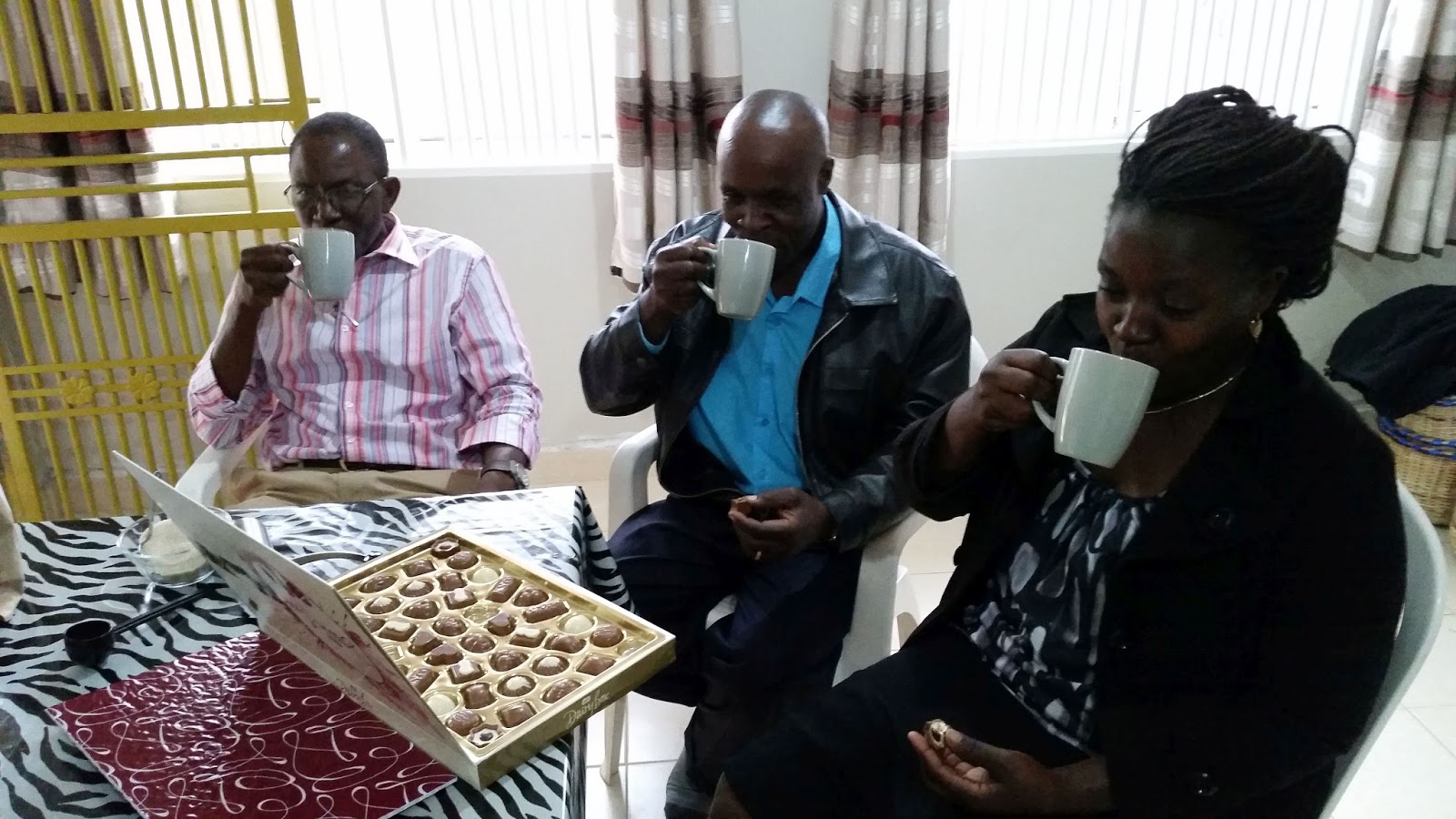
Visitors from the church enjoy chocolates I brought over

Kenyans and us enjoying a m'zungu meal

Sarah's garden after heavy rain

Jon's coffee making was legendary

Sarah does school prep most evenings

Typical Kenyan evening taken just outside their home

20180330

Out of Africa - life in Kenya

A few random photographs of Kenya generally, to give a flavour of the culture there.


On the way to a market in Kisumu,
the half-completed roadworks are a typical scene

The afore mentioned market

These rudely made carcasses will become quite presentable armchairs

A funeral procession, horns blaring, outside our church in Mudete

The same, with a Boda Boda passing by. Crash helmets are rare.

A hardware shop in Mudete. Note the bars and the spelling!

Click to enlarge and check out the writing on the bus

Passing a crowd going to a bull-fight, on the way to Kakamega Forest

Boda Boda delivery man

The main road deteriorates whilst a bridge is being build

Scary scaffolding abounds

Market in Kakamega town

We purchased some mangoes

A pretentious dwelling outside Kisumu 

20180324

Out of Africa - Electrics

One of my tasks whilst visiting J&S in Kenya was to install lighting and a 13A outlet in the new school room. Some allowance had been made during the building work, so there was already a conduit from a 13A socket in the adjacent church to the roof space above the school room.

This post is about what I learnt about Kenyan wiring and some confessions.

The incoming supply is overhead from a roadside pole where only two wires are visible. As far as I could tell, then, the earthing system is 'TT' i.e. the protective earth is supplied by the customer and there is no explicit connection to the supply authority's earth.

I learned that, as a rule, red = Live, black = Neutral, green/yellow = Earth. And that all domestic carcass wiring is done in 20mm black plastic conduit. I say "as a rule" because apparently rules are there only to be broken.


Incoming supply switch-gear

You can click on these images to enlarge them. The picture shows the supply authority's switch-gear which is mounted in a rough metal enclosure on the outside wall of the church. The incoming supply is the black (coaxial?) cable entering at the top and terminates in the DIN-rail double-pole switch at left. This is turn connects to the HXP100DIM metering module via scarily thin wires possible only 2.5 sq.mm. This module has a twin wire data connection to a coin-slot meter inside the church. The supply connects from here to the larger switch on the right where it is joined by an earth cable presumably connected to the customer's earthing rod.

There is a thoroughly normal consumer unit inside the church building with several MCB's which supply lighting and power outlets.


Showing the incoming supply cable in the angled conduit

You'll see that nothing is properly fastened to anything - the supply authority's conduit is roughly supported at a crazy angle only by the geometry of the wall.


Church socket wiring, with my spur connected

Within the church, which is in effect a large single room, there is what I take to be a ring circuit running around the perimeter. It runs in conduit under the plaster but becomes visible at periodic conduit boxes none of which are fitted with lids. For all that effort I could find only two double 13A sockets on this ring, both on the platform. One was hanging (not screwed in). The other (shown above) was properly fastened and was where the provided conduit to the school terminated.  You'll see from this that the colour scheme adopted is:

Green/yellow = Live, green/yellow = Neutral, red = Earth.

In spite of that unfortunate choice the wire gauge appears to be correct i.e. 2.5 sq.mm for Live and Neutral.

My wiring uses the correct Kenyan colours and can be seen connected as a spur in the above picture.  We purchased our wire by the metre at a hardware store in nearby Chavakali.  Here I specified 2.5 for power and 1.5 for lighting, and the store (and I) judged the correct gauge by the larger outer insulator diameter for the supposed 2.5 sq.mm. However when I started working with this wire I found the outer diameter to be a lie, as shown below where I latter compared with wires stripped from Irish 2.5 sq.mm T&E cable.  The bare copper earth wire at top is thus 1.5 sq.mm.

It would appear that the Kenyan green/yellow and black "2.5" is indeed 2.5 sq.mm but the red "2.5" is in fact much less, perhaps 1.5 sq.mm.  And of the two lighting gauge wires at bottom right only the red one is really 1.5, the black being significantly less maybe only 1 sq.mm.

Comparison of wires
Did this matter?  Given the sloppy nature of the wiring generally, our reluctance to go source the correct gauge, and the fact that the two new lights were rated 35W each and that the single double-socket would be used at most only to charge electronic computing equipment, I reckoned not.

According to Irish code an unfused spur from a ring circuit is not allowed, also not allowed is a direct connection from a ring circuit to a reduction in wire gauge for lighting. But I committed both sins, in addition to the wrong wire gauge I had been duped into buying.

But at least all my wiring was in conduit and used the correct colours. Whereas at J&S's house, which had been wired by a "professional" electrician, the conduit stops a few inches short of lighting fixtures so you have single-insulated wire bridging this gap, albeit sometimes wrapped in insulation tape for good measure.

Oh, and when the plumber came to connect a tap to the rainwater tank we had installed, he needed mains power for his electric "welding" machine for PPR water pipe.  An extension cable was not to be had. Indeed his complete tool set consisted only in this rather ancient machine and a couple of plumbing wrenches. We had to supply hack-saw, pipe and fittings, lunch and a drink. So I used some of our recently purchased black lighting wire, connecting into his machine's 13A plug at one end and splicing into the ring main in one of those exposed conduit boxes at the other end, there not being a 13A socket within reach. It did the job, though would hardly have passed health and safety.


20180317

Out of Africa - To Build a School


View from the road


The school room and S making worksheets


Washing hands before lunch

Like I said our primary reason for the trip was to encourage and help with the school project J and S are setting up which you can read about in their words here.  Kenyan building standards are something else and, J's general vision being to redeem, we spent some while removing cement that the builders had kindly splattered over the window frames, in readiness for painting. We also installed electric lights in the school room and a gutter system with tank to store rainwater from the church roof for hand and dish washing. Previously all water had to be purchased and brought in. Now only drinking water will have to be purchased, at least until the tank runs dry which it quickly will in the dry seasons. Here in Ireland we take potable water on tap for granted but there in Africa very few would have this privilege.

Sister B collecting rain water


It rained heavily just after we erected the gutter but before we fed the outlet to the tank. Dinner lady Sister B filled up all the containers she could find with water from the spout and you can see her here braving the downpour. Such is the value of water.


Our gutter system and storage tank completed

Whilst working at the school we participated in the school food prepared faithfully every day by Sister B. A typical lunch is beans and rice and the children put away vast portions this being their main meal of the day. B somehow manages to add interest to the flavour by adding maybe onion or tomato. I couldn't manage all of the portion.

The beans come mixed with dirt and sticks so have to be sorted

Mid-morning every school day B dishes out her legendary "porridge" which I suppose is a mix of various grains. For some of the kids this will be the first meal of their day. It reminded me of my childhood attempts to make "tea" by mixing builder's sand and water and adding grated chalk as "milk". The texture was gritty, like sand, and the taste bland. I manfully finished my first day's mug-full but thereafter declined much to the amusement of Sister B. On the other hand R declared every meal he participated in during the trip as being wonderful and I applaud this sentiment. He is, after all, a growing lad.

Downing B's porridge

My portion

Asked what might be the next major need for church and school, I figured it would be better loo's. At present there is a corrugated iron "shed" with two cubicles, each with sort-of tiled floor with a hole in the middle discharging into a pit beneath. For men to urinate is one thing, but how the Kenyan women often with flowing dresses or robes manage I find hard to imagine. But they do, and succeed, for this arrangement is common. Of course the children also use these loo's and perhaps do not aim quite right.  Inside there is no electric light, no loo paper (you bring your own), no window, and lots of smell. I took pains to arrange my motions to avoid times at the school.

Nap time in the main church building

After lunch the children all take a nap, giving the teachers a break to prepare for the afternoon lessons. Seeing them all on their foam mattresses reminded me of Lewis's dufflepuds asleep.


Hand wash station with our newly installed tap

You'll see our new tap in the picture above. Outside taps like this have to be locked because of the high value of water, even that collected from a dusty roof! Note the swings J designed and erected in the background.


Out of Africa


View from my office

Our road

After being turned away by Dublin airport closing due to snow, we re-booked for two days later thinking all would be well.  It wasn't. After trying everything including prayer we ended up being taken on the back of our tractor to the N81 main road where we were met by an old friend who had agreed to drive us from there to the airport. A small miracle I can assure you. Even on the main roads the journey was not without challenge as some parts on the way to Naas had been cleared only to single vehicle width with drifts either side as high as the car. But we made it, and we figured that our trip to Kenya was providential given the opposition that had been thrown at us: the freak weather, difficulties re-booking through our booking agent, neighbours who told us it was impossible...

And now our two weeks is up and I'm back at home, "we" being myself and my companion R. The joy of walking out of Dublin Terminal 1 into cool fresh Irish air! Nearer home the road-side snow drifts have not yet fully melted and there is still snow on the mountains.

Data and time shortage prevented me posting whilst in Africa but I took loads of photos of which I will share a few publicly in due course.

Our entry into Kenya was at Nairobi airport. Would be visitors note: in addition to purchasing a single-entry eVisa for US$50 ahead of time, on arrival you need a ball-point pen to fill in a buff coloured form. No-one tells you this has to be done, but if you get to the immigration officer without it you are turned back and have to start over. And there are no spare pens to be had: if there had been they would have been stolen.  Armed with passport and both these we got in line again for immigration, then moved on to the baggage reclaim hall, and thence to customs. They had run out of customs declaration forms but this didn't seem to matter. But first do any currency exchange at the desk on the left before customs - it is run by a bank and is kosher. The customs official wanted to see inside our cases: we had various gifts for J&S and their school which the official wanted to tax at 50%. Argument ensued: he held his ground, but after making the point very clearly that we couldn't just bring in anything, he walked away with a smile on his face. That action I later confirmed means "I'm turning a blind eye so beat it". Beat it we gladly did. The next challenge was to find the correct domestic terminal (there seem to be several). Would be visitors note: don't try to figure this one out yourself, just ask a few people: most are very helpful. This way you might save yourself walking aimlessly. The second person we asked turned out to be a self-appointed porter who, I give him his due, did a good job with our heavy cases. I tipped him 200Ksh and he almost leapt for joy. J later suggested 50Ksh might have been more appropriate as 200Ksh is a typical day's wage. For the uninitiated 100Ksh is approximately 1$US, a bit less than 1 euro.


Hebron Community Church, Mudete

From Nairobi we flew into Kisumu (a cinch compared with Nairobi) where we were met by my son-in-law and his pastor who drove us to their homes near his church in Mudete Market. We were duly fed and watered by my daughter S and found our beds and slept off our long journey.

First impressions of East Kenya? Relief to have arrived at last in one piece and with all our bags. Chaotic and exceedingly bumpy driving conditions. Warmth of welcome by all we met. Green vegetation (I had expected everything scorched, but it is the wet season).

The reason for our trip? To visit, encourage and help J and S in their efforts to establish a pre-school and possibly primary school attached to a church in Mudete and to get a flavour of Kenyan life so as to better appreciate and pray for what they are doing now we are back home.

The rest of the story I will spin out in subsequent posts. Because if I wrote everything in one post you'd have given up reading long ago and then my efforts would be wasted as so well expressed by Dilbert.