20150130

Is fantasy wrong?


Maria

Imagination is the stuff of wonder and wonder is what makes things wonderful. But will too much fantasy detract from normal life in "reality"? Like my father once told me, infatuated with a picture in The Sound of Music, that I couldn't fall in love with Julie Andrews. Like, whatsoever things are true, whatsoever things are honest, whatsoever things are just, whatsoever things are pure, whatsoever things are lovely, whatsoever things are of good report; if there be any virtue, and if there be any praise, think on these things. But "true" in the Bible does not equate with "physically material". Indeed the suggestion is that material things are almost the antithesis of truth. When he asked "what is truth?" I think Pilate had an inkling that where he was living at the time was not it.

I have met some who called themselves "Christian" who thought that fantasy is plain wrong. They removed books that verged on the imaginary from their children's shelves. Including Narnia. Rebellious as always I thought the very opposite. Didn't Jesus himself speak in parables?

20150128

The making of Hugo

So how much of those wonderfully detailed scenes in 'Hugo' are real? Not a lot it seems, but that does not, for me, detract from the intense beauty of the film. Isn't that the magic of fiction, of art generally, to enhance, exaggerate, colour, heighten, extend reality? Isn't this exactly what a story teller, a politician, a preacher does to "make a point". Arguably we might not be creators in the strictest sense of the word, but we can still imagine. They can't take that away from us. Imagination is the stuff of wonder and wonder is what makes things wonderful.

You can find several youtube videos on 'the making of Hugo' but this one on Vimeo is perhaps the best and it is in HD. Colour separation overlay or "chroma-key" is used extensively - this technique has been around since the early days of TV but here of course it is enhanced by animated backdrops created by computer.

Chroma-key in action


The original author Brian Selznick whose book the film is based on mixes some real history of  Georges Méliès with his plot and so it is no surprise to find that Hugo's train-crash nightmare is based on a real accident in which a train forgot to stop in a terminus station.

Train wreck at Montparnasse 1895

The Hugo version

in perspective

How I would love to be involved in the making of such a film - behind the scenes of course - I greatly admire the likes of Asa Butterfield but the only acting I can do is the fool.


20150127

Nausia


Paris backdrop - click to enlarge

Tuesday morning. The day before yesterday I was busy as ever, like, ran home from Blessington (from Baltiboys bridge along the lake shore), mended rips in the tunnel plastic, co-hosted a dinner party for 12, then wham... In bed all Monday with stomach cramps and nausea. A bug that has being making the rounds here. So everything in my life froze - I wonder did the world at large notice? In the evening I watched the fantasy 'Hugo' in HD (I had seen before but on a flight so VLD, poor contrast and non-existent sound) and was amazed by the detail in the backdrops of Paris and by the character portrayal - a very beautiful film.


20150124

Catching your dog?

Today, whilst running (barefoot) with Meg, it happened again. Maybe three times now an oncoming car has stopped and the driver rolled down his window to ask "are you trying to catch your dog?". On replying in the negative the driver went on to explain "because you were running in your bare feet..."

Is there some mysterious connection that has hitherto alluded me between loosing one's dog and running barefoot?

And why this "running in your bare feet" as if I were putting them on like shoes? Maybe I run on bare feet (who doesn't?) but I certainly do not run in them. Why not "running barefoot" or even, since shoes are the exception, simply "running"?

20150118

Pageview birthday

Whee!  My blog has just celebrated an important page-view birthday!  To quote...

Pageviews all time history 20,005

20150117

Basic

The beauty of Microsoft's QuickBasic was that you could use it almost as easily as a desk calculator for evaluating simple expressions, whilst at the same time it was a fully fledged programming language capable of running business applications. That I know because I wrote one that got used in a number of hotels without fault for many years.

The closest I have found that will run on a Windows computer is Just Basic which can both emulate the DOS based QuickBasic and can create a Windows GUI. With it you can write a one line program like

PRINT "My fish pie was as big as "; asn(1)*2

Just Basic is a subset of Liberty Basic which you will need to upgrade to only if doing serious stuff. I like their business model: Just Basic is offered totally free even for commercial applications and has no silly restrictions. Or you can get the paid for Liberty Basic which adds a few important extras for a very moderate sum.

The beauty of Visual Basic (VB6) is that creating a Windows GUI program is a doddle. Not quite as easy as QuickBasic but almost. For example, if you want to write a FOR loop to evaluate the Gregory–Leibniz series to an arbitrary number of iterations...


which converges rather slowly to Pi...

in QuickBasic this might be

for n=0 to 100
    pi = pi + ((-1)^n) * 4/(2*n + 1)
next

whereas in VB6 you will have to add to this code a Form (aka Window) onto which you drag a Text-Box or Label to display your result. And name and save the Form and Project source files.

Things only get more difficult with VB.NET. The simplest program, one that prints "Hello World", requires all of:

Imports System
Module Module1
   Sub Main()
      Console.WriteLine("Hello World")
      Console.ReadKey()
   End Sub
End Module

You cannot even easily port your VB6 code to VB.NET. And you are forced to install the bloated .NET framework. Serious programmers claim that VB.NET is much more powerful but I reckon that most of us want ease of use more than power, especially when the "power" being talked about is all about multi-threads and objects and inheritance and stuff that, frankly, we never needed back in those days when they used computers to send men to the moon.

David Platt says it all in his article "The Silent Majority: Why Visual Basic 6 Still Thrives" in MSDN Magazine. If we can believe him then it looks like VB6 is here to stay a while longer. I can testify that it runs under Windows 8.1 although there are a few problems in the editor. But this, I have learnt, is to be expected.

I hope, I hope that Microsoft continue to keep new operating systems backwards compatible with software that people actually use, rather than software that Microsoft want people to use. Like VB6. And another example is Word 97 which does almost everything I want of a word processor and which I therefore still use.

Sorry if I come across like I have a 'B' in my bonnet. I guess I have! But there is an old adage that goes "if it ain't broke then don't fix it".

P.S. Have just found VB6 Zone blog which records that Microsoft have agreed that "VB6 is awesome" and will at least continue to support VB6 runtime until 2024. This is good news indeed.

20150114

Alvin Maker


I am almost through reading Card's first book in the Alvin Maker series. In my last post I suggest that I might be more craftsman than artist. I like building stuff, putting things together, mending things, I cringe under the epitaph "everybody needs a (my name)", so now I am wondering if there is a bit of "maker" in me. Mind you, only about as much maker as Uncle Andrew was a true magician.


The Alvin Maker world is overtly laced with "folk magic". I am OK with this as fiction but it looks a bit too much like Card is proselyting Mormonism. In her excellent dissertation Alma Jean Porschet goes so far as to say "without Joseph Smith there could be no Seventh Son". She sees Alvin as a representation of Smith and identifies things that happen in the novels as suggestive of Mormon history and doctrines. Which begs the question - by continuing to read will I end up wanting to become a Mormon?


20150112

Creation or Consequence?

In the process of moving my office I have been sorting through some old papers and came across the following text which I wrote many moons ago whilst at college, laying in the grass one summer's day in the Botanic Garden.  Since then I ought have become wiser...

"The question "creation, or consequence" arose in connection with a study of musical compositions. To what degree was the composer truly creating his music, as opposed to it coming about due to consequence? It is creativity that is said to distinguish the artist from the mere craftsman, but what if even what we call creativity is really a subtler form of consequential happening?

"For convenience we can resolve any action into its components of so much creation and so much consequence. This of course is only possible if there is such a thing a creation. However, since all events can relate to those that have gone before, creation is never tangible except in the first event of an isolated system.

"The popular assumption that creation does not exist leads many people into incalculable quandaries, especially in the sphere of religion. They say "God created the world and all that is in the world". One might answer "Ah-ha - but what it the world were without beginning, then we could ascribe all creation to consequence" (thus doing away with the need for God). It is interesting to note here that Jewish mythology actually ascribes only the beginning of everything, including the beginning of man, to creation whilst all other formations are consequences."

What little wisdom I have gained since those days of idyllic summer picnics in punts on the Cherwell would suggest that the vast majority (if not all) of what I think I create is actually at best only consequence or simply plagiarism. But maybe that is because I am more craftsman than artist, more engineer than scientist, more practical than spiritual.

There's more stuff in this file too - probably of little interest to anyone but myself but we'll see...

20150107

Lost boys


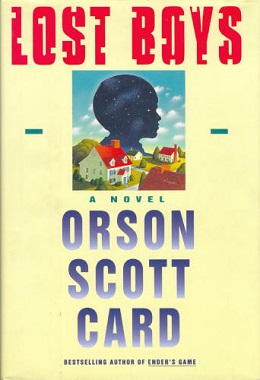
I have just finished reading Lost boys by Orson Scott Card. Incidentally I was struck by similarities between Card's description of the Mormon faith and our own church beliefs. And yet we would not in any way align ourselves with Mormonism. The plot is, of course, infinitely sad with eight boys mutilated and murdered by a seemingly harmless and neighbourly old man. Card manages to cut right through the inhibitions which prevent most of us even voicing things associated with sexual perversion, exposing the weakness of our bodily appetites at the same time as upholding common decency and the strength of character required to control the same. Card's blunt descriptions are the opposite of euphemisms and that is a main reason why I like his writing style, why I was drawn to Ender's Game even though the bluntness almost offended me. We do much harm in covering things up, in not being willing to talk openly when open talking is needed. And I point the finger at myself - I suppose I am frightened of doing so because of what people might think. Indeed one raison d'être for this blog is so that I can try to express things that I find hard to talk about.

After setting the book down we are left agreeing, of course, that the old man must never be allowed to molest again, but not hating and condemning him so much as beginning to understand what drove him to do those terrible things. We are left feeling sadder for him than for his eight victims. Because the same 'Boy', or alter ego, that controlled him, or at least similar weakness, is found in each one of us. O wretched man that I am! Who shall deliver me from the body of this death?

20150106

Tempermental

I used to think I was reasonably musical. I reckoned I could tune a guitar, understand music theory, improvise on the piano, and generally appreciate music better than the average person. Not having yet met the average person I cannot be sure that I was wrong but I have met several non-average people and have come to the conclusion that there are many who are a good deal more musical than I am. Which peeves me because I thought I had a corner. Hence my Song of Albion posts. Which I might yet continue anyway.

As an example - I love the piano - both playing it and listening to it being played. Of course I can tell if a piano is wildly out of tune but I am unaware of the nuances of out-of-tune-ness that some of my friends claim they can detect. But at least I am interested in out-of-tune-ness.

I invented my musical slide rule whilst at school and was intrigued by the idea of enharmonic notes which it manages to discriminate between. Which led to discovering just intonation and the Pythagorean comma.

Pythagorean Comma
Which goes like this:  The seven notes of the major scale are kind of "God-given" in that they result naturally from the vibrations in pipes or strings. The third harmonic of a string or open pipe is a "just" perfect fifth above the second harmonic, the ratio of the frequencies being exactly 3:2. The just perfect fifth is the purest sounding interval after the octave (ratio 2:1) because the ratio is so simple. So two notes are consonant if the ratio of their frequencies is simple. If you start at the bottom A of the piano keyboard and ascend by fifths 12 times you will get to the top A, seven octaves up. If these had been just fifths you arrive at slightly higher than A, this discrepancy being the "comma".

just perfect fifth = frequency ratio 3:2 = 1.5
1.5 raised to power of 12 = 129.746337890625 = 1.0136 x 128 (2 raised to the power 7, thus the top A)
equal temperament semitone = 2 raised to power of 1/12 = 1.0595
thus the Pythagorean comma is about 1/5th of an equal temperament semitone.

The purpose of equal temperament tuning is to divide the octave in 12 exactly equal semitones and thus to avoid the comma.  At the expense of intervals no longer being "just" and therefore not being truly consonant. But it means that music can modulate into remote keys - whereas with just intonation remote keys are out of tune. So equal temperament has heralded the complex harmonies that are commonplace in today's music.

Thus all keys should sound the same thus dispelling the myth that flat keys sound soft and sharp keys sound crisper. Or is it a myth? In fact the piano is not tuned to equal temperament. Because of the stiffness of the piano "strings" the higher harmonics are out of tune - this is called "inharmonicity". To compensate so that higher and lower notes played together don't sound discordant the piano is actually "stretched" or deliberately tuned away from equal temperament.

Railsback curve

Which begs the question - which is the more correct? Just intonation seems to be closer to what I describes as "God given". But then, frankly, who cares? The keyboard (which almost implies equal temperament) is here to stay. And who wants to go back to Gregorian chant? And most of us don't understand the distinction and of those that do, most cannot tell the difference.

And then most of the keys on a piano strike three strings or "unisons" because they are in theory tuned in exact unison see here. Except that this site says "a piano tuner's "secret" is that not all three strings have to be perfectly in tune, a slight difference (which you'll get anyway in a couple of months with regular playing) actually beefs up the tonal quality of the note (chorus effect)". This site claims the reason is to increase the loudness to compensate for the larger bass strings, but I think this is weak reasoning. The force imparted by a given amount of thump on a piano key will be divided three ways when striking three strings thus defeating this argument. Wikipedia and other sites explain that, because the three strings are coupled by the bridge, having three strings lengthens the decay rate although giving an initial sharp decay provided they are tuned in unison - this sounds more believable to me. A side effect of coupling is that it will affect the frequency of vibration thus giving another potential departure from true equal temperament.

This site claims that the three "unisons" may intentionally be de-tuned by an amount that is culture dependent - "The effect is to change what stage of a played note the tuning resolves for maximum appeal. In the American style, the attack, or initial sound is emphasized for optimum 'in-tuneness' tonality. In the Japanese style, the sustain, or the sound of the note after the initial strike fades is where the highest degree of 'in-tuneness' resolves. In the European style, influencing the overall color of the note is the goal."

Which views are rather confusing and not always consistent.

I have access to several pianos including a grand. I cannot comment on their relative degrees of in-tune-ness - at the moment they all sound OK to me - but the one I hands-down prefer is an upright: for its crispness of tone, its responsiveness to and lightness of touch, and its great dynamic range.

20141228

Miles with Meg

Sunday afternoon, down to the lake with my son, his family and friends, then a ten mile run with Meg. It was cold but very beautiful. One oncoming car stopped short and the passenger got out and and came up to me, very concerned, saying "you have bare feet and it is very cold..." I tried to explain that I was fine, my feet were fine, but I do not think she was convinced. I didn't get as far as pointing out that the dog was bare foot too. Actually my feet were not at all cold but my hands (also bare) were. Holding a camera doesn't help.

My latest grandchild (and mother)

Cameras are contagious

Two more grandchildren

My son


A study in Cow and Dog

Kings River forked rock

Just to prove it was cold

20141227

Solaris


I have finished reading the 1961 novel Solaris that I mentioned in my last post. I rank it as one of the better sci-fi books I have read because of its disturbing realism. None of these humanoid extra-terrestrials that are now so common - here all attempts to make satisfactory contact with the alien fail and yet it wreaks havoc. The characters, with all their inhibitions, distrust and confusion, are not straightforward. Many questions in their and the reader's minds are purposely left unanswered. Which all resonate with common experience.

The protagonist Kris Kelvin falls in love with an alien-created avatar of his long-deceased love Rheya and doggedly will not accept that she will probably cease to exist on leaving Solaris for Earth. Even after his colleagues force the issue by destroying the avatar, and some semblance of normality has returned, he ends up abandoning his original plan to return to Earth and the book ends "Must I go on living here the, among the objects we both had touched, in the air she had breathed... In the hope of her return? And yet I lived in expectation. Since she had gone, that was all that remained... I persisted in the faith that the time of cruel miracles was not past".

Earlier in the book Kris observes: "We all know that we are material creatures, subject to the laws of physiology and physics, and not even the power of all our feelings combined can defeat those laws. All we can do is detest them. The age-old faith of lovers and poets in the power of love, stronger than death, that finis vitae sed non amoris (the end of life but not of love), is a lie, useless and not even funny... Are we to grow used to the idea that every man relives ancient torments, which are all the more profound because they grow comic with repetition? That human existence should repeat itself, well and good, but that it should repeat itself like a hackneyed tune, or a record a drunkard keeps playing as he feeds coins into the jukebox..."

I found all this disturbingly reminiscent of emotions that rattle around in my ego. I hold onto relationships and principles without fully understanding why I do so. I find it difficult enough to even quantise such feelings myself, let alone explain them in writing. Had I been born, for example, to Hindu parents in India I wonder how different my inner thought processes, expectations and beliefs would be? The comparison is of course void because, if I had, I would not be "me". So maybe I am destined to remain an unknown quantity to myself - I know, O LORD, that the way of man is not in himself, that it is not in man who walks to direct his steps. 

Several films have been based on the book and there are numerous web sites on the subject. For example, if you want an in depth description of the manifestations of the alien "intelligence", try here.

20141223

Dreams


I'm reading Solaris, a 1961 science fiction novel. It is set in the distant future and has a good attempt to predict computer technology except they have to wait for the valves to warm up - and yet they still use tape recorders!

So, maybe because I went to sleep after reading about these weird humanoid manifestations, I dreamt that the door to my bedroom was opening (I was sleeping alone, Ali having been visiting her mum - which may be why my blog-posting has been above par recently). I instantly woke up, quite alert, and thankfully was able to verify that in fact the door was firmly closed.

Which says something about dream vs. reality time-lines. Experience confirms that long dreams can sometimes occupy very little real time space. And yet this one was synchronised to the second.


I can also verify that dreams can definitely be in vivid colour and that I can both hear and be heard and be understood. A recurrent dream-theme I have mentioned before is my ability to "fly". Odd perhaps but not unique although you get some pretty weird stuff if you Google it. In these dreams I sort of push inside (a little bit like the pushing one does to defecate only located much higher up) and if I push hard enough sometimes, but only sometimes, is it enough to raise me off terra-firma. Once levitated then I can soar more freely, though usually I am limited in height and duration. Whilst flying I remain approximately upright - never zooming horizontally like Superman. In that other realm, reality, I have often tried this pushing but sadly with no effect (yet).

The experience sometimes includes the ability to jump unusual distances. Typically I can be at the top of a high stairwell and jump down ridiculous numbers of steps and yet land gracefully. And in my dreams I try to be surreptitious as I get embarrassed about what other people must think of my antics.

I mention my flying ability here (how I wish I could do it for real) because of the amazing scenery in these dreams - I am awed by the rapid changes of perspective and panorama as I navigate. On a recent occasion I was impressed by the richness and complexity of the tapestry of landscapes - it seemed as if I was aware that I was in a dream and yet everything looked so real and the thought occurred to me - how could my paltry imagination come up with such splendour?

Sci-fi writers, and more recently Physicists, have played with the idea that what we think of as reality may be little more than a dream. One wonders who is doing the sleeping? The cornflakes I ate just now seemed pretty real and I can still feel them rummaging around inside me but soon, come a few hours, they will be little more than a memory. All our reality is but an instant in time that evaporates rapidly into ephemeral memory. And neither is our future secure: at best it is only hope: hope deferred makes the heart sick, but a desire fulfilled is a tree of life.

Which is, I suppose, why man builds edifices, like the many standing stones here in the British Isles, many with ogham inscriptions. Whilst distance may lends enchantment and memories may dull with time, a stone pillar with obviously man-made markings is visible proof that folk really existed and lived their lives all those years ago. I wonder if, in my life, I have made any permanent marks...

20141221

A letter to Santa


Gay Byrne

Gay Byrne, veteran and much loved Irish TV and radio presenter, hosted a show on Lyric fm this afternoon in which he read A letter to Santa by Irish novelist John Sheridan. It presents a different take, and one I liked, on Santa than the more common commercial-push-over or the religious-I-don't-want-anything-to-do-with-it approaches. I couldn't find all the text but here is a sample from the above link:

Once-- and not so long ago-- Europe, at this blessed time of year, was a blaze of lighted church-windows, carols meant more than carousals, and red, symbolic candles shone out from a million sills to guide your landings. But the lights grow fewer every year, and a great darkness is spreading over the face of Christendom.

You were always a legend, Santa, but now they are trying to make you a lie; and you were never a lie. You were, rather, a logical necessity. You just had to be invented. You stand, not just for a parable, but for a whole medley of parables.

You represent, for instance, the belief that prayers are heard-- and answered; the belief that time and space do not exist in the spiritual dimension; the belief that there is a Bounty that is not embarrassed or diminished by the number of clients or the immensity of their needs.

...

That is why I am still prepared, in spite of the cost of living, to act as your local representative and depot superintendent until my Illustrious Virtues [his children] find both of us out; why I am prepared to perpetuate a legend that looks like a lie but is merely a cloak for the truth; why I can say, literally and with all reverence, that the tiny things I have wrapped in brown paper and hidden away against the Vigil of the Feast are part of the Deposit of Faith.

But sure, who am I telling it to?

20141220

How much is enough?


How much is enough? How far should I try to impose my will on someone: on my pupil, my employee, my spouse, my under-age son or daughter, my friend, or even my friend's dog?

I watch parents insisting that their offspring do this or that, things that sometimes seem unreasonable to me, and then either recapitulating or metering harsh punishment when the child does not or cannot comply and has got into such a tizzy. Not that I didn't make plenty of mistakes when I had young children.

I grant that, to maintain any semblance of order, there do need to be accepted lines of authority but none of us like to be forced to do something that is unreasonable.  In the Le Petit Prince the king's "rule was not only absolute: it was also universal."

"For what the king fundamentally insisted upon was that his authority should be respected. He tolerated no disobedience. He was an absolute monarch. But, because he was a very good man, he made his orders reasonable.

" 'If I ordered a general,' he would say, by way of example, 'if I ordered a general to change himself into a sea bird, and if the general did not obey me, that would not be the fault of the general. It would be my fault.' "

I find this hyperbole to be a useful premise in my dealings with other folk, although it does rather tend towards the lowest denominator. In contrast was our new music teacher at secondary school who galvanised me (and others) from musical indifference to singing in the school choir (once I even sang a solo in a school concert, can you imagine?) and playing flute in the school orchestra. For this I honour him, and others like him who can believe and instil the unbelievable in others. For the general to be able to fly like Jonathan Livingston Seagull would have been a wonderful thing.


The point I am trying to make (maybe not very well) is summed up in the term "human dignity". Martin Luther King declares it in his "I have a dream that one day this nation will rise up and live out the true meaning of its creed: 'We hold these truths to be self-evident: that all men are created equal.' ". That I should aim to honour and respect equally every person regardless of their age, station, nationality, health, cleanliness or creed.

I know that I should be impartial, that I should love those that hurt me. I would love to be the sort of teacher who imparts life and not just knowledge. One who lives by and upholds Godly standards. I have these things as my aim, but I am sorry to say that I have yet a ways to go.

20141218

Jack London


At school my English teacher would occasionally hand out a list of a zillion book titles that literate boys were meant to have read. Generally I could find two, maybe three, titles that I recognised. But two books that immediately appealed to me back then were Jack London's Call of the Wild and White Fang.  (Another was Laurie Lee's Cider with Rosie). It is the power of description in the books that I loved.

And so it was with expectation that I recently picked up Martin Eden. In a lone battle struggling to become a writer whilst standing against convention Martin eventually finds financial success but the novel ends with him loosing purpose and committing suicide. I found the ending unexpected and utterly bleak.

As an atheist Jack London is quoted as saying:

"I believe that when I am dead, I am dead. I believe that with my death I am just as much obliterated as the last mosquito you and I squashed".

Like Thomas, I have plenty of doubts and loose ends. But I find this statement untenable, just as I found the novel bleak. As I have mentioned in my page on faith I go along with Puddleglum's sentiments:

"We're just babies making up a game, if you're right. But four babies playing a game can make a playworld which licks your real world hollow. That's why I'm going to stand by the play-world. I'm on Aslan's side even if there isn't any Aslan to lead it."

It has been said that man was made with a God shaped hole which only He can fill. It would seem that most people do not agree with this, but then most people believe that a diamond is a girl's best friend.


20141212

Polar Express

The Polar Express

Talking about wonder, a film I greatly enjoyed watching a few Christmas's back was The Polar Express. Why did I enjoy it so? Maybe because it was the first digital film I saw that was anywhere near lifelike. Or because it used the digital medium to such advantage in portraying the children - obviously synthesised and yet embodying real, lovable, hesitantly inquisitive humanity. Or because of the scene in which the train runs off track, a theme I have often dreamt about even before I saw this film. In such dreams I am riding a train careering along roads or even rough tracks across county, whilst I am pondering how the wheel flanges are making out... But then I am a siderodromomaniac.


And of course I liked the hit song I'm wishing on a star...


Towards the end Santa gives the boy a magic bell and the film ends with a twist: the boy, now grown up, says:

"At one time, most of my friends could hear the bell, but as years passed, it felt silent for all of them. Even Sarah found one Christmas that she could no longer hear its sweet sound. Though I've grown old, the bell still rings for me, as it does for all who truly believe."

Which moral could be taken in more ways than one. A number of internet sites suggest that the film might have an overtly Christian message, for example see here or here or here or here or here - and there is even the suggestion that the producers intended it.

I am left wondering... how insignificant can that which our faith hangs on be before we conclude that the object of our faith was but a dream? Blessed are they who have not seen and have believed.

For me, this film is entertainment at its best. Mind you, not all the critics agreed, but then they wouldn't.

20141210

Fish pie, Rachmaninoff and Hamlet


Boys School, Smock Alley Theatre

Last evening I accompanied my wife and friend to a performance of Hamlet at the Smock Alley theatre, Dublin. The venue was interesting and the acting was good, I am sure, but Shakespeare isn't my scene even if it is his 450'th birthday. I find it too wordy, stilted, abrasive and foreign. Like - a morass of words (no doubt clever but the cleverness passes me by) hung on a thin skeleton of props and acting. I had done my homework so roughly knew the plot, but I couldn't follow all the speech partly because the actors spoke so quickly, or quietly, and partly because my hearing is not the best. Our friend said he had the same problem and he is only a teenager. And then the plot is not exactly uplifting. Most of the characters end up being murdered. About the only element of wonder I found was to consider whether Hamlet's motives were at all honourable. Whilst revenge is understandable it is hard to see why one should be entertained by it. So, all in all, I found it rather hard and unrewarding work. Sorry, for those of my readers who may think Shakespeare plays are the bee's knees: I will not stand in your way!

Anyway, to continue my argument - at one point in the play there was Ophelia, who was probably expressing her love for Hamlet at the time, when the first movement of Rachmaninoff 2nd piano concerto started playing in the background. My attention was immediately absorbed by the music and I wished it could have continued, that we could have dispensed with the rest of the play.

So why do I find music so much more engaging that talking? It is a bit like my vast preference of fish pie over a complicated dish such as an avant garde restaurant might serve. Fish pie is good all the way through. No surprises, just plain old reliable good. Especially with cheese on top and ketchup and peas. I can become immersed in the experience: it is sensual, pleasing, I am carried by and can identify with it. Granted, sheer pleasure is not the only reason for doing stuff - just possibly I have become educated and more erudite by attending Hamlet - but surely entertainment should be entertaining? Just occasionally a poem might light my fire but, generally, I don't do words well - words are functional and I can get frustrated with people who use more of them than I think necessary. Whereas - if music be the food of love, play on...

20141208

A long ago story

A tale of wonder... from the same little blue book (another one) that I mentioned in my post In a far country:

A long ago story

...The years fled away. And still the Great Tree stood among the mists, unharmed by time and the lightnings that felled so many of its proud neighbours. But still the years followed one another endlessly; and at last, old and withered, the Great Tree crashed and fell into the muddy waters of the swamp. Down to the bottom of the swamp it sank, crushed underfoot by the mighty reptiles that fought one another, bellowing and screaming and coughing through the short night hours ; or pushed and jostled, and rolled in the steamy ooze of the daytime, as they sought their prey. Deeper and deeper into the mud, at the bottom of the swamp, the tree was pressed, until at last it rotted and fell to pieces. But the ball of gum with the fly at its core was unharmed by the mud and the water. It was too small for the giant feet of the great reptiles to crush it, and so it lay there safely in the darkness of the thick slime. The years fled away in tens and in hundreds and in thousands. The sea broke over the land, and where the swamp had been, the little waves of a blue deep sea rippled from shore to distant shore.

Unnumbered and countless years flew by. Man appeared upon the earth, a little, helpless, naked creature, whose brain was to make him lord of all. And so, slowly, slowly, ever so slowly, man conquered the earth ; built upon it fair and wonderful cities ; and launched upon its seas his painted ships. And the great oozy swamps, the vast trees, and the crawling reptiles, were forgotten as if they had never been.

And then, but yesterday, a little boy walked along the beach, after a high spring tide had thrown the shells and seaweed a score of feet beyond the wonted tide mark. The sun shone, and the sand was warm and pleasant to his bare feet. Suddenly his bare toe touched something hard and round, and as large as a sparrow's egg. He picked it up, and gave a little cry of delight. It was amber. But it was rough and dull, and he did not dream of the treasure at its heart.

He took it up to the tiny shop upon the windy cliffs. And there the little old man, who spent his days polishing and cutting stones, set to work upon it. The little boy's fair hair and the old man's scanty gray were very close as the polishing proceeded rapidly. And then the little boy screamed out, and pointed to the piece of amber now as yellow as gold and as clear as glass. The little old gray man gasped. There in the very heart of the amber lay the body of a beautiful blue fly, with one glittering gauzy wing outstretched ; it was the fly that had died so suddenly in the young, young days of the old world.

Fly in amber

And now, set in gold, the fly-in-the-amber, that is older than the hills, rests in a case in a great building for all the world to see. And day by day folks passing by stop to stare at its wonderful beauty.

But the proud tree that boasted, in those far off ages, of its long, long life, was lost and forgotten before ever man came upon the earth ; little, naked, defenceless man, who was one day to be lord of all.

20141206

My birthday?


Fish Pie à ma mater

Mine!

All for me!

Me having a real birthday? My birthday still?

Many thanks to all you who thought about me. And thanks for the Facebook wishes. And for the gifts. It's kind of nice to have a birthday even if one doesn't believe in them!

I had a magnificent dinner - fish pie as my mother made it - although I had to make it myself as Ali took the grandchildren out out to see Swan Lake.

I do not have an official recipe so the following is roughly what I did tonight and is based on what I can remember of how my mother's fish pie tasted. It worked - everyone who partook said they enjoyed it.

Take some fresh white fish (e.g. cod - in this instant it was hake), NOT smoked. Poach it for about 10 minutes in one pint of milk (one pint is good for 4 people). Drain and put to one side to cool. Retain the milk.

Peel and boil some potatoes. Drain and mash with butter, milk salt and freshly ground black pepper.

Using the same saucepan as you poached the fish it, melt 2 oz of butter, take off the heat and mix with 2 oz of plain flour to make a roux. Slowly add the hot milk mixing well all the time. Return to a gentle heat and bring to the boil stirring all the time thus making a thick white sauce. Do not use cornflour!

Grate about 4 oz of cheese, and add a little less than half to the white sauce.

Remove any skin from the fish and give to the cat. Flake the flesh and extract any bones.

Take a deep oven dish, grease with butter, and use about 1/3 of the mashed potato as a base layer. Pour half the white sauce over this layer. Now arrange the fish over the potato and cover with the remaining white sauce. Carefully spoon the remaining potato on top, level and fork, then cover with the remaining cheese.

Bake in an oven for about 30 minutes, if necessary grill to brown the cheese.

Serve with peas, tomato ketchup and white wine, and share with your best friend.